Google Ads Changes Budget-Limited Campaign Bidding: What It Means for Your Business
Google Ads is introducing another significant update. This time to its automated bidding system. Changes are due to take effect from 17 August 2026. The update is mainly for campaigns using Target CPA (Cost Per Acquisition) and Target ROAS (Return on Ad Spend).
The change affects campaigns that are marked as ‘Limited by budget.’ Google wants to deliver more consistent and predictable performance when advertisers adjust their budgets or bidding targets. The update will improve campaign stability. Businesses with campaigns that currently outperform their bidding targets may notice changes if they don’t review their settings before August 17th.
Understanding how these changes work is important. Reviewing your campaigns now can help you make sure your bidding strategy still supports your marketing objectives. It also means you can avoid any unexpected shifts in performance after the update.
In this guide, we’ll explain what’s changing, why Google is making the update, how it could affect your campaigns, and the practical steps you can take to prepare before the changes go live. If you want personalised support, consider booking in with us for a strategy session.
What Is Changing in Google Ads?
Google Ads offers a range of automated bidding strategies designed to help advertisers achieve specific goals. Two of the most widely used are:
- Target CPA (Cost Per Acquisition). This generates conversions at a desired average cost.
- Target ROAS (Return on Ad Spend). This focuses on achieving a target return from advertising spend.
These strategies use machine learning to adjust bids in real time. They do this based on signals like user behaviour, device, location and likelihood of conversion.
Until now, campaigns marked as ‘Limited by budget’ have often behaved differently from what advertisers expected. In some cases, these campaigns have actually outperformed their bidding targets. For example, a campaign with a Target CPA of £40 might consistently generate conversions at an average cost of £22. This is because Google’s bidding system found highly efficient opportunities within the available budget.
While this may sound like good news, it has also created challenges. If an advertiser later increased their budget to capture more traffic, campaign performance could become less predictable. Costs might rise unexpectedly, for instance. Or the campaign could struggle to maintain the same level of efficiency. This makes it difficult to forecast results or scale with confidence.
Google is updating its bidding system from 17 August 2026. This means that budget-limited campaigns using Target CPA or Target ROAS will more consistently perform towards the bidding target that has been set.
Using the earlier example, a campaign with a Target CPA of £40 that is currently averaging £22 may begin delivering results much closer to the £40 target unless the advertiser lowers their target beforehand.
Google says this will create more stable and predictable performance. This will be the case particularly when budgets are adjusted. However, it also means advertisers should review whether their current bidding targets still reflect the outcomes they actually want to achieve. It means you shouldn’t rely on campaigns that have been quietly outperforming expectations.
Which Campaigns Will Be Affected?
The update only applies to a specific group of Google Ads campaigns. You might not notice a change. It affects campaigns using Target CPA or Target ROAS bidding strategies that are also displaying a ‘Limited by budget’ status within Google Ads.
The campaign types included in the update are:
- Search campaigns.
- Shopping campaigns.
- Performance Max campaigns.
- Demand Gen campaigns.
If your campaign uses one of these formats but isn’t limited by budget, or if you’re using a different bidding strategy altogether, this update is unlikely to have a direct impact.
Campaigns using Maximise Conversions, Maximise Conversion Value, Manual CPC or Enhanced CPC are not part of this change. Likewise, campaigns that have sufficient budget to meet demand won’t experience the new bidding behaviour. This is true even if they use Target CPA or Target ROAS.
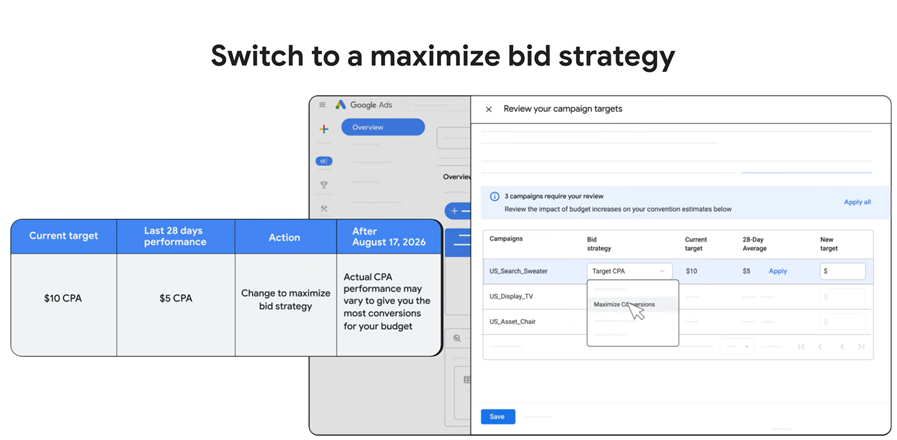
Image source: Changes to target based bid strategies – Google Ads Help
If your business is running multiple campaigns, it’s worth checking each one individually rather than assuming the update applies across your entire account. Google has also introduced notifications and a new Bid Target Adjustment Tool. This will help advertisers identify any affected campaigns and review whether their bidding targets remain appropriate before the changes take effect.
What Does ‘Limited by Budget’ Actually Mean?
If you’ve ever seen a campaign labelled ‘Limited by budget’, it can sound like something has gone wrong. In reality, it’s just Google’s way of telling you that your campaign could generate more traffic or conversions if it had a larger daily budget.
Google uses this status when its systems identify more opportunities to show your ads than your current budget allows. Once your daily budget has effectively been allocated, Google may stop entering your ads into some auctions, even if there are additional users searching for your products or services.
Simply put, your campaign isn’t reaching its full potential. Budget, and not demand, is the limiting factor here.
You can usually identify this status within the Campaigns view in Google Ads. It appears alongside your campaign’s performance metrics. It’s worth checking regularly. If you have campaigns that are consistently hitting their daily budgets, it’s important.
Being ‘Limited by budget’ isn’t necessarily a bad thing. For many businesses, it simply shows there’s been a deliberate decision to control advertising costs. If your campaigns are delivering profitable leads or sales within your available budget, that’s great. You may have no immediate reason to increase spend.
The key is understanding how your budget and bidding strategy work together:
- Your daily budget determines how much you’re willing to spend.
- Bidding strategies like Target CPA and Target ROAS tell Google how efficiently that budget should be used.
These are two separate controls, but they influence each other.
With Google’s upcoming update, advertisers running budget-limited campaigns will need to pay closer attention to both settings. If you look at your budget alongside your bidding targets, you can ensure your campaigns continue to deliver results that align with your business objectives. And you won’t just be relying on historical performance.
Why Is Google Making This Change?
Google says that the update will make automated bidding more consistent and predictable for advertisers who use Target CPA and Target ROAS. Currently, budget-limited campaigns can sometimes achieve results that are significantly better than their bidding targets. This may appear beneficial, but it can make campaign planning more difficult. When businesses want to increase their budgets and scale their advertising, it’s particularly problematic.
When you make your campaigns perform more closely to their specified targets, Google believes you will have a clearer understanding of what to expect from your campaigns. If you’ve set a Target CPA of £40, for example, Google wants the system to consistently deliver conversions at around that figure. It doesn’t want this to fluctuate between £20 one month and £40 the next.
This should also make campaign scaling more straightforward. It used to be that increasing a campaign’s budget could sometimes lead to unexpected changes in cost per acquisition or return on ad spend. It made it harder to forecast results. Google’s revised bidding system is supposed to reduce this volatility. Advertisers will likely have greater confidence when they adjust budgets or want to expand a successful campaign.
The update also shows the direction of travel Google’s heading in. Over recent years, the platform has introduced increasingly sophisticated AI-driven bidding and automation features. This has allowed machine learning to take on more of the decision-making process. Advertisers are being encouraged to focus on setting clear business objectives instead manually adjusting bids for individual keywords. Google’s algorithms then optimise performance in real time.
However, automation doesn’t mean you don’t need strategic oversight. Google’s bidding system can only optimise towards the targets it is given. If the targets no longer reflect your desired cost per lead or return on investment, even the most advanced AI will optimise towards the wrong objective. Automation is becoming more and more powerful and so setting realistic and regularly reviewed bidding targets is more and more important too.
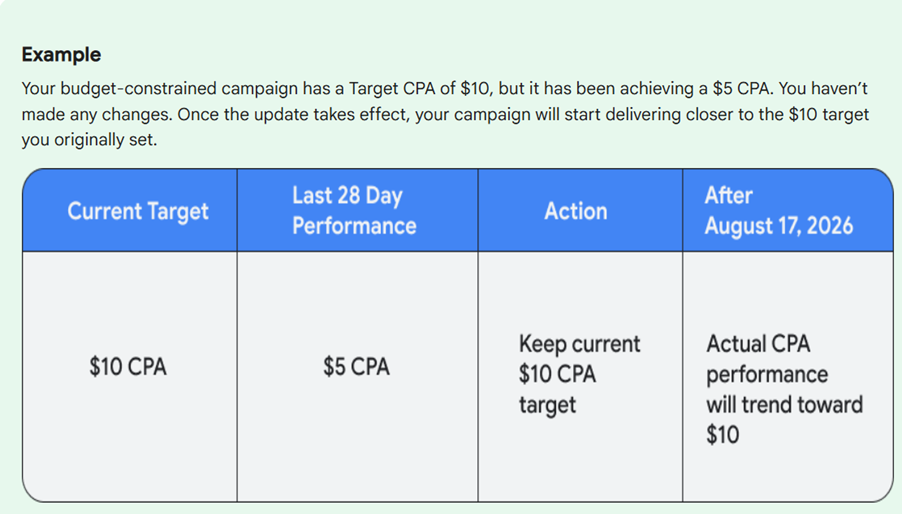
Image source: Changes to target based bid strategies – Google Ads Help
How Could This Affect Your Campaign Performance?
The impact of this update will largely depend on how your campaigns are performing today. If your Target CPA or Target ROAS already closely matches your actual results, you may notice very little difference after the changes take effect. However, businesses whose campaigns are significantly outperforming their targets should pay particular attention.
For example, imagine your campaign has a Target CPA of £40. Over the past several months, it has consistently generated new customers for £22 each. Under the current system, Google has been able to find enough high-quality opportunities within your available budget to outperform the target you’ve set. From 17 August 2026, the bidding system will instead aim to deliver performance much closer to the £40 target unless you decide to lower it.
This doesn’t necessarily mean your campaign is becoming less effective. It could mean that Google is following your instructions more accurately. If you’ve told the platform you’re happy to pay up to £40 per conversion, its bidding system will optimise around that figure. It’s not going to significantly exceed your expectations.
The same principle applies to Target ROAS campaigns. If your campaign has consistently delivered a higher return on ad spend than your target, you may find results settle closer to the percentage you’ve specified after the update. Again, this isn’t a sign that Google’s algorithms have become less efficient. It just means there’s a closer alignment between your stated goals and campaign performance.
If you regularly review and refine your bidding strategies, these changes may have little impact, if you don’t, you may find that historical performance has been masking outdated targets and that they no longer reflect your commercial objectives. If you take the time to review your campaigns before the rollout, you avoid any unexpected shifts in lead costs or return on investment. Our experts at Key Principles can help you with reviewing your PPC strategy.
Ultimately, the important question isn’t whether performance changes. It’s whether your bidding targets accurately reflect your goals.
What Should You Do Before 17 August 2026?
Google has stressed that no action is required if you’re happy with your current bidding targets. That said, it’s worth reviewing your campaigns before the update is rolled out. Being proactive can help you make sure your campaigns still deliver the results you expect. It can also minimise the risk of any unexpected changes in performance.
- Start by reviewing all campaigns that use Target CPA or Target ROAS.
Pay particular attention to those displaying a ‘Limited by budget’ status. If your account contains multiple campaigns, don’t assume they’ll all behave in the same way. Assess each one individually. - Next, compare your bidding targets with your actual results.
For example, if your Target CPA is £50 but your average cost per acquisition has consistently been around £30, ask yourself whether £50 still reflects your commercial objectives. Similarly, if your Target ROAS is significantly lower than the returns your campaigns are regularly achieving, it may be worth updating your target to better align with current performance.
Google has also introduced a Bid Target Adjustment Tool. This is designed to help advertisers review historical campaign data. You can use it to identify where bidding targets may no longer be appropriate. The tool doesn’t make automatic changes. It gives you recommendations based on recent performance. You can then decide whether or not to adjust your targets.
Once the update has rolled out, you should monitor your campaigns closely. It’s normal to see some short-term fluctuations while Google’s bidding algorithms adapt so give things time. Don’t make several changes at once. Give campaigns sufficient time to stabilise and you’ll then have a much clearer picture of how the update is affecting your results.
Your pre-update checklist
Before 17 August 2026, make sure you:
- Review all campaigns using Target CPA or Target ROAS.
- Identify any campaigns marked ‘Limited by budget’.
- Compare your bidding targets with your actual CPA or ROAS performance.
- Decide whether your existing targets still reflect your business goals.
- Use Google’s Bid Target Adjustment Tool to review recommended changes.
- Monitor campaign performance after the update and make measured adjustments where necessary.
Doing this will help ensure your Google Ads campaigns continue to deliver predictable, cost-effective results once the new bidding system is fully in place.
Common Mistakes
It’s tempting to react quickly whenever Google introduces changes to its advertising platform. Making rushed decisions can sometimes do more harm than good.
One of the biggest mistakes? Ignoring Google’s notifications. If your account is affected, Google will show you relevant campaigns and give you access to the new Bid Target Adjustment Tool. These alerts help you identify campaigns that may benefit from a review before the changes take effect.
Another common error is increasing your budget without reviewing your bidding targets. A larger budget doesn’t automatically improve performance. If your Target CPA or Target ROAS isn’t aligned well with your desired outcomes and then you increase spend on it, it might mean Google optimises towards an outdated target.
Don’t assume that a higher CPA always means poorer performance either. If you’re generating more valuable leads or increasing overall conversion volume, a slightly higher acquisition cost may still give you a stronger return on investment.
Look at the bigger picture. Don’t focus on a single metric. This will lead to better decision-making.
Finally, but importantly, resist the temptation to change multiple settings at the same time. If you adjust budgets, bidding targets, keywords and ad copy simultaneously, it makes it difficult to know which change influenced performance.
After the update rolls out, monitor your campaigns carefully. Allow time for Google’s algorithms to adapt. Then, make gradual, data-driven adjustments if you need to.
Final thoughts
If your business uses Target CPA or Target ROAS, now is the time to review your campaigns before the update takes effect on 17 August 2026.
The platform can only optimise towards the goals you set. Ensuring those goals are realistic and up to date means you campaign performance will be cost-effective and predictable.
Being proactive today means you could prevent unexpected changes in costs and efficiency. Contact Key Principles today to review your account now so that you’ll be in a much stronger position come August.