Responsive Search Ads (RSAs) are now the standard format in any Google Ads Search campaign. If you’re running search campaigns, you’re already using them whether you’ve actively chosen to or not.
On the surface, the format looks straightforward. Instead of writing one fixed ad, you provide multiple headlines and descriptions. Google then assembles these in real time. It shows combinations it expects to perform best for each individual search based on advanced machine learning.
More combinations should mean more relevance. More relevance should mean better results. That’s the theory.
It doesn’t always play out like that in practice. Some advertisers see consistent improvements. Others end up with ads that feel generic, inconsistent or simply underwhelming in performance.
The difference comes down to how the ads are built. It’s rarely down to the platform itself.
RSAs aren’t a shortcut. They don’t replace good structure, clear messaging or strong offers. They rely on those things.
This guide looks at how to create RSAs properly, what tends to go wrong, and how to improve performance once your ads are live. If you need help with any of this, get in touch with Key Principles and we can help.
What are Responsive Search Ads (and why they’re important)
Responsive Search Ads allow advertisers to provide multiple headlines and descriptions within a single ad. Google then rotates these assets. It tests different combinations across searches.
You can include:
- Up to 15 headlines.
- Up to 4 descriptions.
- A bespoke URL path to add more keyword content.
Each time a user searches, Google selects a combination based on what it predicts will perform best in that moment. Headlines are arguably the most important part. Even in the 1960s, it was recognised. One commonly-quoted British advertiser, David Ogily, said, “On the average, five times as many people read the headline as read the body copy.” This was in his 1963 book Confessions of an Advertising Man, long before internet advertising was a thing.
The changes show how we’re moving towards automation within Google Ads now. Instead of controlling every element manually, advertisers can guide the system by supplying high-quality inputs. It works—but only when we use genuinely useful inputs.
A common issue is that many advertisers include headlines that are too similar to each other. They might be technically different, but they don’t provide meaningful variation. The system then has very little to optimise.
RSAs are important for this as they’re now the default way search ads are delivered. If they’re weak, your campaigns are weaker.
How RSAs actually work
RSAs are built at auction time. When a user searches, Google evaluates your available assets and assembles an ad based on multiple signals:
- The search query.
- The user’s past behaviour.
- Device and location.
- Historical performance data.
Over time, the system identifies which combinations are most effective. It then shows them more frequently. Less effective combinations appear less often or drop out entirely.
This creates a form of automated testing. But this isn’t the same as a controlled experiment. You don’t get clean A/B comparisons. Performance shifts more gradually instead and it’s all based on how assets interact.
Looking at this, we can see why variation matters so much. If all your headlines communicate the same idea, then there’s nothing meaningful for the system to learn from.
You’ll also see an Ad Strength rating in Google Ads. This measures how varied and complete your ad is instead of how well it performs. It can be useful as a guide, sure. It shouldn’t drive decision-making on its own though.
But it is important to know that an “Excellent” Ad strength rating doesn’t mean your ad is effective. It just means it meets Google’s formatting preferences. So, if your click through rate’s (CTR’s) are high you don’t need to chase the higher strength rating.
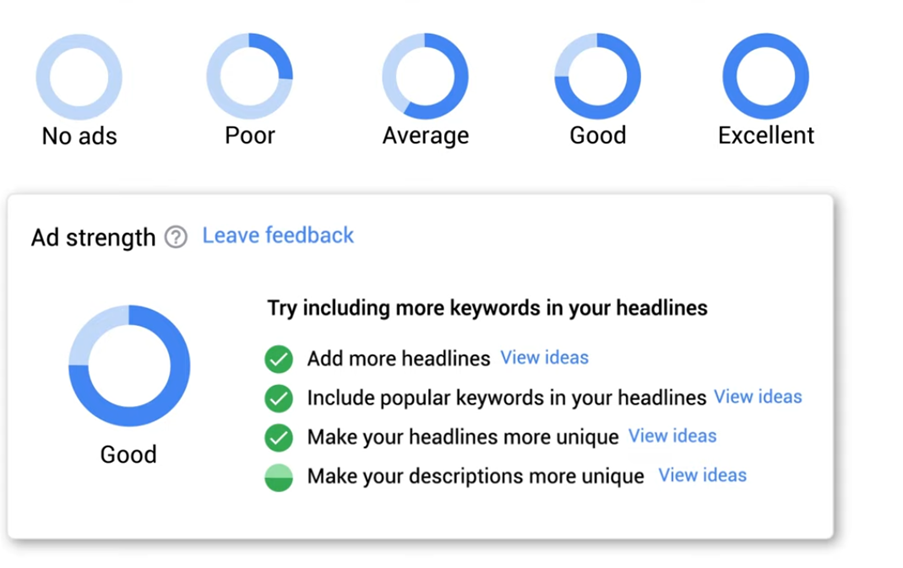
Image source: Google Ads Tutorials: About responsive search ads – YouTube
How to set up a Responsive Search Ad properly
The technical setup is simple. The thinking behind it is where most advertisers don’t reach the mark.
Headlines
You can add up to 15 headlines. More isn’t always better. You want to create a set of headlines that cover different angles rather than trying to fill every available slot.
A strong RSA usually includes:
- Keyword-driven headlines.
- Benefit-led messaging.
- Proof or credibility signals.
- Calls to action (CTAs).
Each headline should serve a purpose. If two headlines say essentially the same thing, you don’t need one of them. And people are led to act on their emotions, so think about what problem they have when they are searching for your product or service and trial offering the benefit-led messaging based on emotion.
Descriptions
Descriptions allow you to add context. Use them to:
- Expand on your offer.
- Reinforce benefits.
- Address any objections.
Avoid repeating the same sentence in different wording. Focus on different angles instead.
Final URL
Your landing page should match the intent behind your ad. If someone clicks expecting a specific service or product, they shouldn’t have to search for it once they land. Misalignment can undermine even a strong ad.
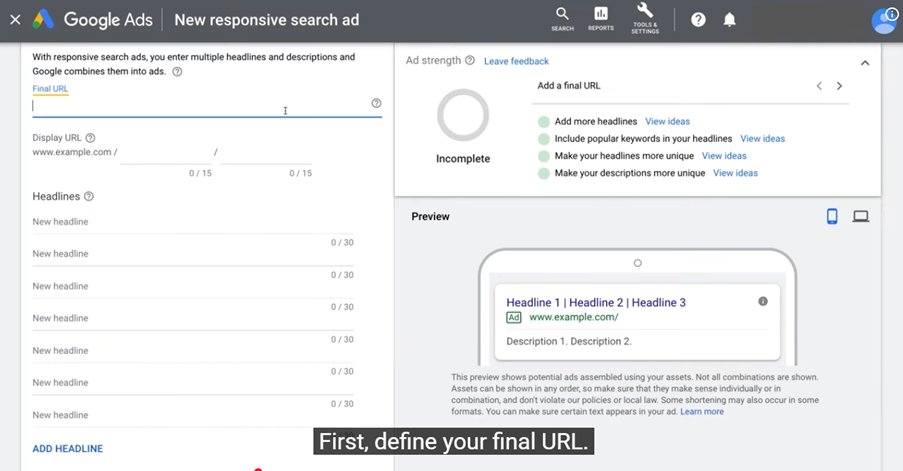
Image source: Google Ads Tutorials: About responsive search ads – YouTube
But don’t worry if your URL wording doesn’t match the ad content, you can tailor how your URL looks by adding up to two bespoke URL paths that match the advert and landing page content to make your ad more relevant:
https://your_website_name/path_1/path_2
Pinning
Pinning fixes certain assets in place. It’s useful and needed, but data shows that is now shouldn’t be overused.
It makes sense for:
- Brand messaging.
- Compliance requirements.
- Critical information that must appear.
Too much pinning can reduce flexibility and prevent effective testing, but no pinning at all could mean that your ads just don’t make any sense.
Writing headlines that actually perform
This is where most of the impact comes from. Writing 10–15 headlines isn’t difficult. Writing 10–15 headlines that are genuinely different is. You want to cover multiple angles without losing clarity.
Keyword alignment
Some headlines should reflect what users are searching for directly:
- “Google Ads Management Services”
- “PPC Agency for Ecommerce Brands”
These improve relevance and make sure the ad matches the query.
Benefits
Others should focus on outcomes:
- “Increase ROI From Your Ad Spend”
- “Generate More Qualified Leads”
This is where you start to differentiate.
Proof
Trust reduces hesitation:
- “Trusted by 100+ UK Businesses”
- “Proven PPC Strategies That Scale”
Without trust and proof, ads can feel interchangeable with other organisations.
Calls to action
Users still need direction:
- “Get a Free PPC Audit”
- “Speak to a PPC Specialist Today”
Structural variation
This is often overlooked. If every headline follows the same pattern, any variation becomes superficial. Changing a single word doesn’t create a meaningful difference.
Mix:
- Short and long headlines.
- Direct and descriptive phrasing.
- Questions and statements.
A simple comparison makes the difference clearer:
| Weak variation | Strong variation |
| Best PPC Agency UK | Struggling with Google Ads Performance? |
| Top PPC Agency UK | PPC Agency Focused on ROI |
| Leading PPC Agency UK | Reduce Wasted Ad Spend Today |
The second set gives Google more to work with.
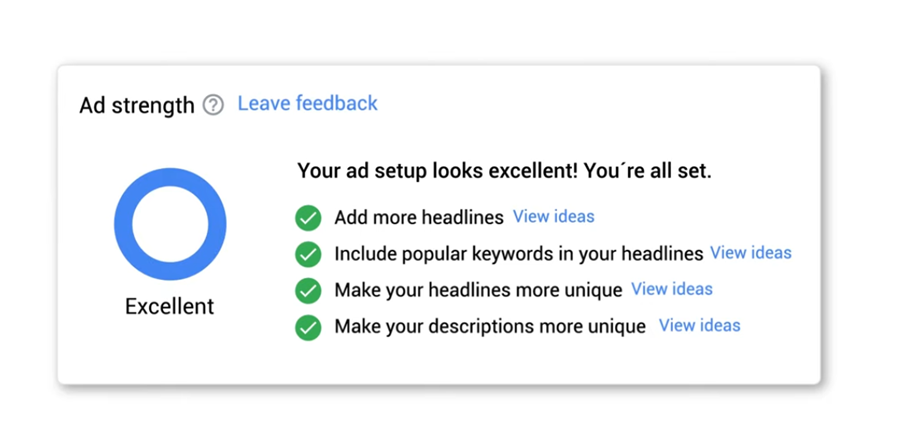
Image source: Google Ads Tutorials: About responsive search ads – YouTube
Using descriptions more strategically
Descriptions are often treated as an afterthought, but these reinforce your message. Instead of repeating headlines in different words, use descriptions to:
- Add detail to your offer.
- Explain how your service works.
- Highlight differentiators.
- Address common concerns.
If your headline focuses on performance, for example, your description could explain how that performance is achieved. This creates a more complete message across the ad. You’re not just repeating the same idea.
Remember, with a Google Search campaign, you have very small character limits to work with, so use these wisely and don’t repeat your message within the same ad.
A practical example: weak vs strong RSA setup
Need some more examples? Here are some weak RSA setups compared to strong ones:
Weak RSA
For headlines, using “Best PPC Agency,” “Top PPC Services” and “Affordable PPC Agency” would be weak because they’re too similar.
For descriptions, “we provide high-quality PPC service” and “improve your ads with our expert team” aren’t going to do you any favours. There’s no clear reason to click. Everything is vague and repetitive.
Strong RSA
Compare those examples with the following strong headlines:
- PPC Agency Focused on ROI.
- Increase Your Google Ads Performance.
- Trusted by 100+ UK Businesses.
- Get a Free PPC Audit.
- Reduce Wasted Ad Spend.
Here are some better descriptions:
- Improve campaign performance with a structured, data-led PPC strategy.
- Identify wasted spend and scale what’s working with clear reporting.
These versions give Google real variation and give users clearer reasons to engage.
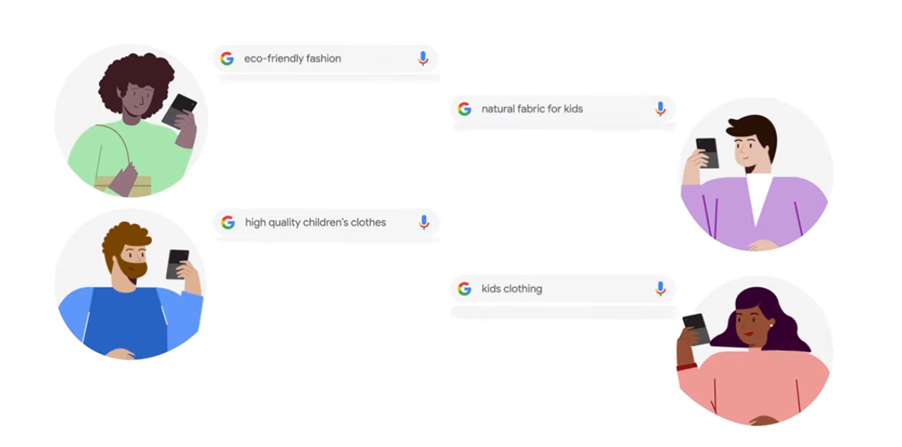
Image source: Google Ads Tutorials: About responsive search ads – YouTube
Common RSA mistakes
It’s easy to make mistakes. These are the most common ones we see:
- Repetition: Headlines that say the same thing limit performance.
- Over-pinning: Too many pinned assets remove flexibility.
- Generic messaging: If your ad could apply to any business, it won’t stand out.
- Ignoring intent: Your messaging should reflect what users are actually looking for.
- Weak differentiation:If you don’t explain why you’re different, the ad becomes interchangeable.
Optimisation tips that work
Once your RSAs have gone live, don’t just forget about it and hope for the best. Performance will rarely improve of its own accord. Most advertisers leave things too long or make a random change without a clear idea of what they’re trying to do. Small adjustments along the way usually make the biggest difference:
- Use asset performance data
Google labels assets as Low, Good or Best. This highlights patterns even though it’s not perfect. Replace any weak assets with new ideas; small edits won’t really work at this point.
- Refresh ads over time
Performance can plateau. Update headlines to introduce new combinations if you notice stagnation.
- Keep ad groups focused
Broad ad groups will reduce relevance. Tighter themes improve performance.
- Test different angles
Don’t just rewrite. Change your approach entirely. Think about the difference between ‘price’ and ‘value’ and ‘feature’ vs ‘outcome.’
- Balance variation and clarity
Too much variation can dilute the message. Too little limits testing.
How to test and improve RSAs over time
You need structure for the best outcomes:
Step 1: Identify weak assets
Step 2: Replace with new angles
Step 3: Allow time for data
Step 4: Repeat
Doing this means you can create steady improvement rather than making reactive changes.
Advanced RSA considerations most advertisers miss
Once you’ve got the basics in place, there are a few additional layers that can make a noticeable difference.
Message sequencing
RSAs are dynamic but combinations still tend to follow patterns. Think about how your headlines might work together.
For example:
- Headline 1: problem or trigger
- Headline 2: solution
- Headline 3: proof or CTA
Even though you don’t control exact combinations, if you build assets that complement each other, you increase the chance of a coherent message.
This way you can build out different variations of your RSA based on the messaging, one might be price led, another based on high quality or customer service, then you’ll be able to appeal to all types of your audience.
Brand vs non-brand variation
Brand searches don’t behave in the same way as generic ones. For brand terms, users already know who you are. This means your messaging can focus more on reassurance, offers or next steps.
For non-brand, you need to establish relevance and credibility quickly. This often means separating campaigns or at least tailoring RSA messaging to reflect intent.
Competitor pressure
In competitive auctions, small differences in messaging matter even more. If multiple advertisers are offering similar services, your headlines need to differentiate clearly. Otherwise, users default to price, familiarity or positioning.
What kind of results should you expect?
Performance varies widely depending on industry and competition.
PPC benchmarks from WordStream suggest the average click-through rates for search ads range is 6.66%. The average conversion rate is 7.5%. These are based on 16,000 campaigns from the 2024/2025 financial year. Of course this will fluctuate depending on your industry.
RSAs can outperform these averages, but only when they’re well built. A weak RSA won’t outperform a strong traditional ad. A strong RSA can outperform both.
The format itself isn’t the advantage, the execution of it is. For more guidance on your PPC strategy, our team of experts are waiting to help you.
How RSAs fit into your overall PPC strategy
RSAs are in between keywords and landing pages in your strategy. They translate intent into messaging. If your keyword targeting is unclear, RSAs struggle. If your landing page doesn’t convert, stronger ads won’t solve it either.
Improving RSAs is often part of a wider PPC review. Many businesses see their biggest gains coming from aligning structure, messaging and targeting.
If you’re reviewing your campaigns, it’s worth looking at this within your wider PPC strategy, or booking a strategy session to identify where performance can improve.
Final thoughts
To summarise, Responsive Search Ads are flexible, but they’re not forgiving. They allow variation but you need strong inputs.
The accounts that perform best usually pay attention to:
- Genuine variation in headlines.
- Clear differentiation.
- Strong alignment with intent.
- Ongoing testing and refinement.
Google can optimise combinations, but it can’t fix weak messaging. That part still comes down to how the ad is built.