It’s been talked about for a long time, but as 2026 starts, it finally feels like the shift from control to automation is done. This year, it’s been about learning. 2026 is when we discover the consequences. Budgets are being allocated by systems that reward signal quality over structure, inputs over micromanagement. Now, advertisers don’t just manage Google Ads. They’ve become feeding systems.
This doesn’t mean strategy is dead. It’s simply changed tack.
Some reliable PPC tactics are quietly losing effectiveness. Advertisers haven’t done anything wrong in this respect, but Google is depreciating them; they’re not a priority. At the same time, new levers are gaining traction—data quality, intent signals, asset inputs and how well accounts support automation. Resisting it is futile.
This article looks at the PPC tactics that are starting to fall by the wayside as we move into 2026. More importantly, we explain why Google is depreciating them so you know what to focus on to stay competitive. Human decision-making still matters—you just need to know where.
Before you lock in 2026 budgets, a strategy session can make all the difference. You can sense-check where your account is exposed and where it’s well-positioned for what’s coming next.
The Bigger Shift: Google Ads Is Now an Input-Based Platform
Google Ads was, for a long time, a platform with a lot of levels. You pulled keywords, bids, match types, placements and budgets in an attempt to force a desired outcome. If performance dipped, you adjusted. If it rose, you doubled down.
That’s gone.
Google has shifted its stance. Manual optimisation is no longer. Outcomes are driven by signals.
First came Smart Bidding. Then, broad match with intent signal powering. Then, Performance Max. Now, the pattern is obvious: Google Ads is not asking how you want to be seen; it’s more about what you want to achieve and the data you’re feeding in.
Granular control is disappearing bit by bit. Match types behave differently. Placement exclusions aren’t as important. Attribution windows? Increasingly abstracted. Transparency is still around but it’s not what the platform is built on.
It might be uncomfortable, but what Google wants from advertisers in 2026 is simple:
- Clean, reliable conversion data.
- Strong intent signals. Especially first-party audiences.
- High-quality creative that can flex across formats.
The account manager’s role obviously has changed now. Less time tweaking bids and search terms. More time designing systems that give Google the right inputs to work with.
This is the context for everything that follows. Certain PPC tactics aren’t dying because they’re “bad.” It’s because they don’t fit into an input-based system.
So, without further ado, here are our 2026 predictions for Google Ads.
1. Phrase Match Keywords: Too Loose to Control, Too Tight to Scale
Phrase match felt like a sensible middle ground. Not as restrictive as an exact match. Not as risky as broad. For years, it was the “safe” option for those who wanted a bit of reach without a complete handover of control.
That safety net is no longer.
Google’s understanding of intent has moved far beyond match types. When pairing broad match with Smart Bidding and strong conversion signals, Google interprets behaviour in ways that phrase match can’t keep up.
Meanwhile, the exact match has tightened again. It offers clear boundaries when control genuinely matters.
And phrase match? Now it sits in an awkward middle space. It often misses valuable intent because it’s still tied to wording, not meaning. A subtle, but important distinction. At the same time, it pulls in irrelevant searches that, on the surface, look similar but don’t match commercial intent at all. It all results in a limited scale without the expected precision.
A clearer split works better:
- Use exact match where control is non-negotiable, like with core brand or high-intent terms.
- Use broad match where growth matters, supported by strong bidding strategies, audiences and clean conversion data.
The practical takeaway is simple. Phrase match shouldn’t be your default anymore. If it’s still propping up large parts of your account, you probably need to rethink your structure. A full query review, like those we carry out through our PPC search audits, can help realign your campaigns with how Google Ads now works.
2. The Slow Fade of Dynamic Search Ads (DSA)
DSAs are still sitting in a lot of accounts. Often untouched. Often doing “okay.” And that’s exactly why this matters.
Dynamic Search Ads were built for Google of the past. A simpler version of Google Ads. They filled gaps where there was thin keyword coverage and gave advertisers a way to capture long-tail searches without endless build-outs. For a long time, their purpose was clear.
Now, not so much.
DSAs sit uncomfortably alongside Performance Max and AI Max. All three are, in different ways, keyword less systems. They rely on Google interpreting intent, content and behaviour. It doesn’t make much sense to maintain three overlapping approaches. Not for Google, and not for advertisers who are trying to understand what’s driving performance.
You can already see the direction of travel. PMAX absorbs inventory across channels. AI Max bundles broad match, asset customisation and URL expansion into a single switch. DSAs, though, feel frozen in time. They haven’t meaningfully evolved. And they don’t receive the same level of production attention.
When it wants something to disappear, Google doesn’t announce it. Instead, tools are quietly side-lined. They’re absorbed into newer formats or left to wither with better options taking their place. It seems that DSAs are heading this way.
Don’t panic yet. But start preparing nevertheless. Move keyword less testing into AI Max or PMAX. Treat DSAs as legacy support, not a growth lever.
This doesn’t mean you need to chase new features constantly. The goal is to stop building strategies around tools that are being left behind.
3. AI Max Isn’t New – But Google’s Push Is
There’s been no sudden breakthrough here. Most of what sits behind AI Max has been in accounts for years. Broad match expansion. Final URL expansion. Asset customisation. None of that is new.
What is new is how Google has packaged it.
All of these features under a single toggle mean Google has lowered the barrier to adoption. You’re “all in” with one click. From Google’s point of view, it makes sense. Fewer decisions for advertisers. Faster learning for the system. More data flowing into automation.
The problem is, easier doesn’t mean safer.
AI Max doesn’t replace strategy. It’s all about what you feed into it. Strong signals, clean data and well-structured accounts tend to benefit. If you’ve got messy targeting, vague landing pages and weak conversion tracking, you’ll get exposed quickly.
The toggle doesn’t fix fundamentals. What it does do is remove the friction that used to force advertisers to think before switching things on.
It’s easy to come unstuck. AI Max will happily expand reach, rewrite messaging and shift traffic across pages, but if you’re not clear on what success looks like, it can inflate volume and erode quality. At a headline level, it might look fine, but intent could be drifting underneath.
That said, AI Max can work very well when used properly. It suits accounts with:
- Strong first-party data.
- Clear conversion properties.
- Enough volume to train the system.
If you use it too prematurely, it becomes a blunt instrument.
In 2026, don’t adopt it blindly. Control the rollout. Test deliberately. Ring-fence budgets. Watch search terms, landing pages and conversion quality closely.
4. From Keywords to Signals: How Campaigns Will Really Be Built
One thing feels increasingly clear for 2026: campaigns won’t be built around keywords the way they used to be. Keywords aren’t dead. But they’re no longer the main ingredient in the recipe.
You may not even have realised it’s been happening, but search behaviour has changed. People used to type two-word queries and hope for the best. Now, they’re asking full questions. They’re refining searches mid-way through. They’re moving between devices and touchpoints, using voice search. A single keyword doesn’t capture this kind of intent.
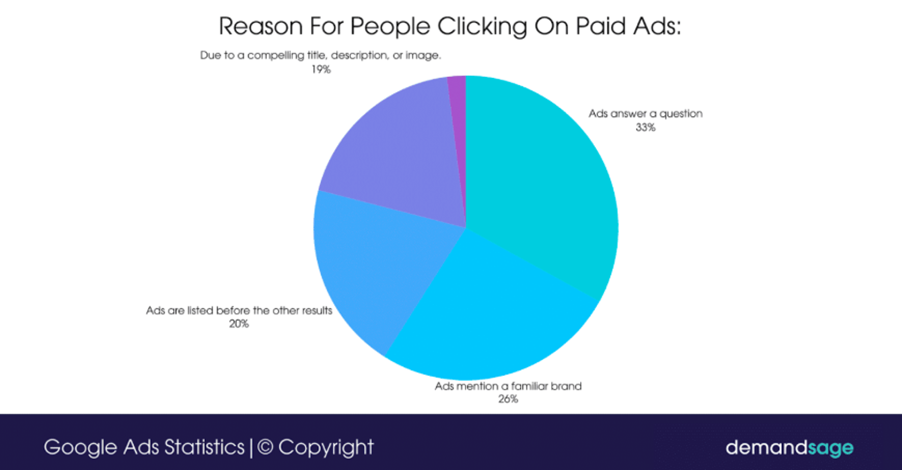
Image source: https://www.demandsage.com/google-ads-statistics/
Google’s systems are responding to the behavioural changes. They’re looking beyond the query itself. This is where “signals” come in. This is a word that gets used loosely, but it does have a specific meaning in practice.
Signals are the extra context Google uses to decide who sees an ad, not just when it’s shown:
- Customer Match lists.
- In-market audiences.
- Browsing behaviour.
- Location patterns.
- Device usage.
- Previous interactions with the brand.
Individually, they’re nothing new. What’s changing is how central they’ve become to campaign performance.
Keywords still matter.
More as anchors than drivers, though.
They define relevance, but the heavy lifting is done by the signals you’ll find layered around them. Broad match paired with strong audience data often outperforms tightly curated keyword lists with no supporting context.
It’s not complicated to prepare for this shift, but you do need to be disciplined:
- Start by layering audiences in observation mode. Then, you can see how different signals perform before you hand over control.
- Clean up CRM uploads. Make sure Customer Match lists are accurate and up to date. Conversion tracking needs to reflect real value here, not vanity actions.
- Align your Google Ads strategy with your first-party data strategy.
In 2026, the accounts that win won’t be the ones with the biggest keyword lists. They’ll be the ones feeding the system the clearest picture of who their customers actually are.
5. Performance Max Matures – and Advertisers Push Back
PMAX felt like the answer to everything. Switch it on, feed it assets and let the system do the rest. Results often looked good, especially at first. It meant people often assumed PMAX was always the best-performing type of campaign.
In 2026, that myth is wearing thin.
In truth, PMAX often plateaus. It’s great at finding the easiest conversions—branded searches, returning customers, warm audiences. Over time, growth slows. New customer acquisition becomes harder to measure and, in some cases, harder to achieve at all. The campaign still reports healthy numbers, but the incremental value is less clear.
Those with advanced understanding have started to push back. Transparency with PMAX is limited, which means it can be harder to control brand safety. Attribution is blurred. Especially so if there’s an overlap with Search, Shopping and Display. You know conversions are happening. You just don’t know why.
And so, we’re seeing a shift toward more hybrid structures. Standard Shopping is being reintroduced for product-level control and clearer attribution. Search campaigns are used deliberately for intent capture and query insight. PMAX still has a role, but it’s positioned alongside these, not above them.
No one’s rejecting the automation. But they’re trying to recalibrate it.
Used in isolation, Performance Max as a tool hides problems just as easily as it drives results. It’s not a strategy on its own. When used alongside Search and Shopping, it can become far more effective (and far easier to trust).
6. Video Becomes Unavoidable (Even If You Don’t Want It)
I hate it as much as the next person, but making video stops being optional as we get into 2026.
Google’s push is coming from one place: revenue. YouTube continues to grow. Shorts inventory is expanding fast.
Google has made it clear where it wants ad spend to go. PMAX didn’t accidentally require video assets. That was just a signal that it needs video to unlock its full reach. And what that means is that advertisers need to supply it.
For many brands, there’s friction. Not every business has the appetite (or budget and confidence) for full-scale YouTube campaigns. And that’s fine. This isn’t about becoming a video-first brand overnight.
The baseline expectation is changing, however.
If you run Performance Max, you’re already in the video ecosystem. If you don’t supply a video, Google will generate it for you. That’s where the risk lies. Auto-generated videos are functional, but they aren’t always on-brand, well-paced or contextually accurate.
Left unchecked, they can dilute messaging or misrepresent products.
You need to accept it and control it. It can’t be ignored. Not everyone needs a YouTube-first strategy. You just need short, clean assets, clean branding and a vertical option for Shorts. There’s got to be enough structure for the automation to have something solid to work with. If you’re a PMAX advertiser, you have to be video-ready now. Maintaining an anti-video stance in 2026 means you’re handing creative decisions to the machine.
7. Ads in AI Overview & AI Mode: Visibility Without Control
Ads are already appearing inside Google’s AI-generated answers. The problem with this is control—or rather, the lack thereof.
You can’t choose to show in AI Overview. Nor can you opt out. You can’t bid higher or lower for those placements. And crucially, you can’t see a clean report that tells you when your ads appeared there, or why.
It’s uncomfortable if you’re an advertiser. You’re spending your budget in environments you didn’t explicitly select, against queries that you may never see, inside conversations you can’t audit. It’s a gap that’s becoming harder to ignore as more and more users rely on AI Mode for answers rather than traditional search results.
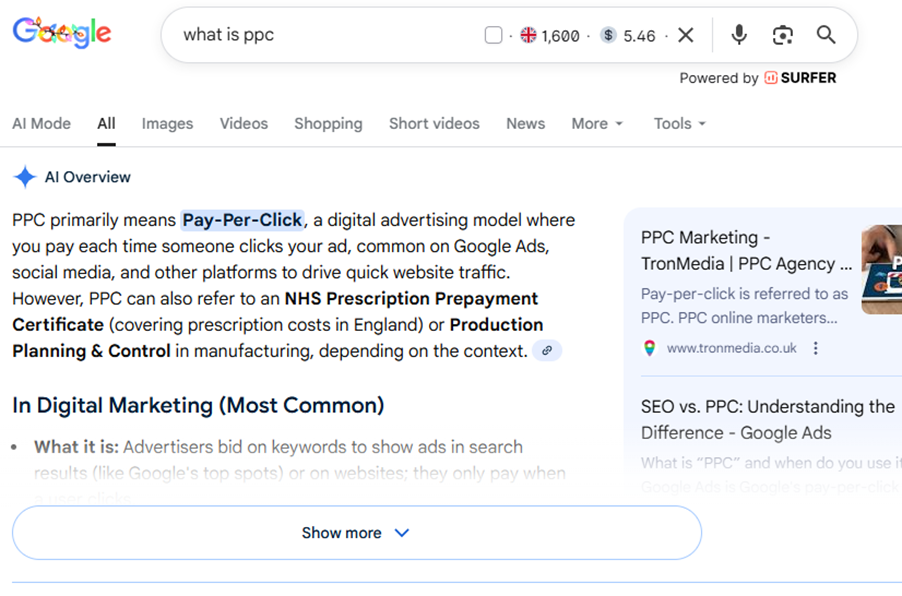
What it means is that decision-making is detached from reality. The blurred performance data makes it harder to judge whether spend is incremental, brand-safe or being absorbed by “helpful” placements that don’t convert.
So what can you do now?
Focus on what you can control. If your signals are solid, your ads are more likely to appear in the right contexts. Even when placements are opaque.
What Smart Advertisers Will Do Differently in 2026
The most successful advertisers in 2026 won’t be the ones trying to claw back control that doesn’t exist anymore. They’ll be the ones who accept the changes and work with them.
Google Ads is a system that now depends on what you feed into it.
This means less micromanaging and more focus on fundamentals:
- Inputs, not tweaks. Clean data matters more than clever bid adjustments.
- Strong signals. First-party data, audience layers and clear intent give automation something to work with.
- Creative quality. Video, imagery and messaging are core inputs now.
- Data hygiene. Accurate conversion tracking, sensible attribution and aligned goals are non-negotiable.
Smart advertisers know when and when not to automate. Not every campaign needs every toggle switched on. Restraint is now a strategy in its own right.
Automation isn’t going away, and in 2026, the best-performing accounts will be the ones designed deliberately, not constantly “optimised.” They’ll feed Google better data, make clever strategic choices and avoid automation for automation’s sake.
If you want to future-proof your Google Ads accounts before 2026 budgets are locked in, it’s worth stepping back now. Contact Key Principles to review your strategy and make sure your accounts are built for where Google Ads is heading, not where it used to be.