There’s been a definite change in how search is being talked about. AI tools like ChatGPT, Google Gemini & Claude have come to the fore and it’s easy to assume traditional search like Google or Bing is starting to lose ground. Some headlines—the sensationalist ones-go even further and suggest that SEO is becoming less relevant.
That’s not what’s actually happening, though.
Search hasn’t disappeared. People are still using search engines every day to find services, compare options and make decisions. AI hasn’t replaced this, though we could say it’s added another step before it.
People are moving through information differently; they’re not moving away. AI is great for exploration, search that helps make decisions. When a business understands this difference, and they get it right, it makes a difference.
Search Isn’t Going Anywhere (And the Data Still Proves It)
AI is everywhere. Despite the noise around its use, search (so far) is still the default way people navigate the internet.
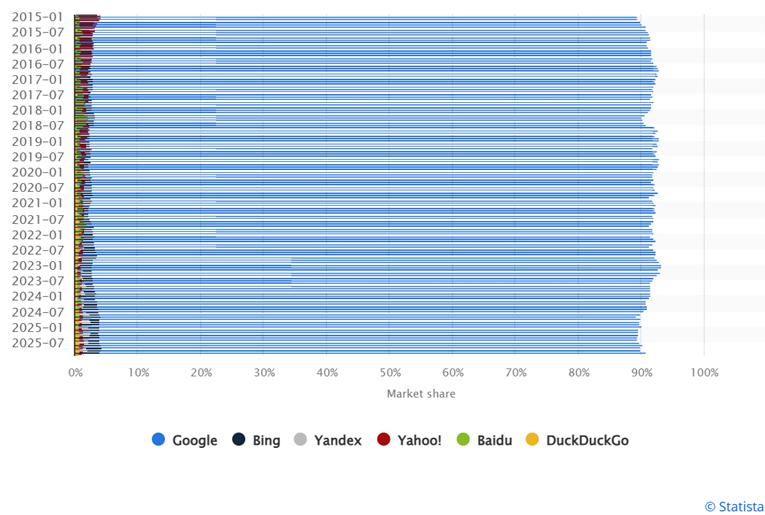
Market share of leading search engines worldwide from January 2015 to December 2025
Global search engine market share 2025| Statista
When someone wants to find a business, check a price or compare options, most people don’t open an AI tool first, the data shows the large majority still head to Google and search. That behaviour is ingrained quite deeply; it’s fast and familiar and people trust it. AI is getting better, but it still does generate inaccurate results at times unless your prompt is perfect, which, let’s face it, when we’re trying to find something quickly, it isn’t.
Search still dominates when intent is clear. So, when you’re:
- Looking for a specific product or service.
- Comparing providers or pricing.
- Finding local businesses.
- Checking reviews or credibility.
AI tools can support some of this, but they don’t replace it and their results aren’t as great. There’s still a gap when it comes to trust and transparency too. Users want to see where information comes from. They know AI generates answers and can be false. Search gives options and means people can click through and validate things themselves.
That’s where search remains stronger.
| Behaviour | Search | AI |
| Real-time information | Strong | Limited |
| Source transparency | High | Lower |
| Local intent | Strong | Weak |
| Transaction intent | High | Low |
In short, search still ‘owns the moment.’ It’s still the place where decisions are made. AI may help develop the thinking beforehand but it rarely replaces what follows.
Statistics on Generative AI use in Search Engines
A Statista survey showed that 44% of users were using AI for helping them learn things or to have concepts explained. 37% said they used it for recommendations. These are the top two figures and the only ones that correspond to search and discovery. All of the other use cases were:
- Improving writing – 40%.
- Summarising information – 40%.
- Translating language – 32%.
- Organising daily life – 29%.
- Generating personalised plans – 31%.
- Providing entertainment – 29%.
- Designing and editing digital content – 29%.
What stands out is that most AI usage sits outside of direct search intent. It’s being used as a support tool, not a replacement for finding and choosing services.
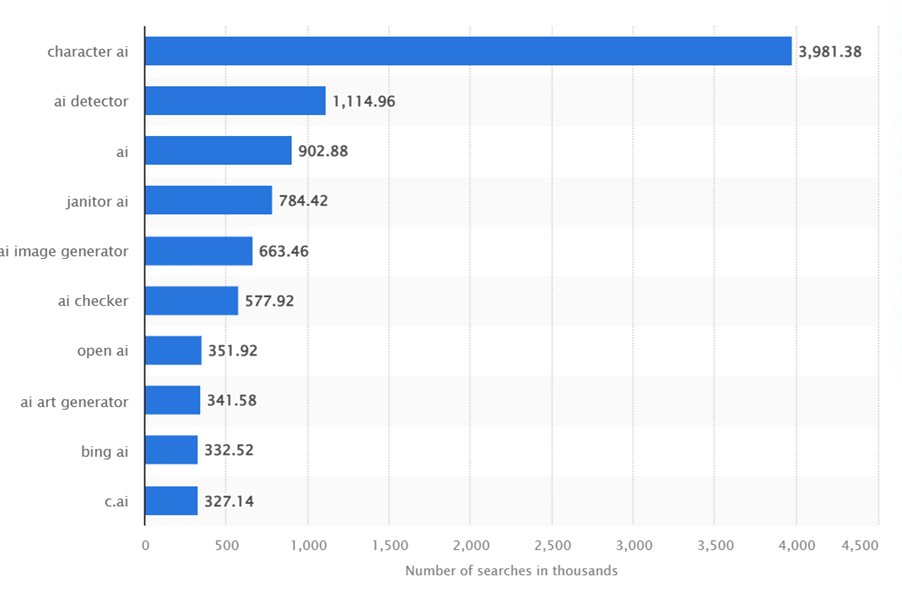
Artificial intelligence (AI)-related online searches in the United States from January 2023 to December 2024, by monthly search volume U.S. AI-related online searches 2024| Statista
What AI Is Actually Changing (And Why It Matters)
As mentioned, AI is being used in the first stages of research. People used to head straight to Google search to help with understanding a topic, looking at options, making ideas and getting a summary of some information.
Now, AI does this best. ChatGPT, for example, is a natural fit for these queries. It makes the beginning of a query easier to work through. There’s no need to click multiple pages and read lengthy blog articles when you can just ask one question.
However, this convenience has limits. AI responses are often broad. They’re helpful for direction, but when it comes down to specifics, they’re less helpful. There’s also a lack of visibility around sources which can then add time to the search because users want to double-check anything important.
So, while AI changes how people start, it doesn’t remove the need to continue. Search behaviour is more layered:
- AI for exploration.
- Search for validation.
- Websites for decision-making.
That middle step, search, is still doing a lot of the work.
Search vs AI Isn’t a Competition
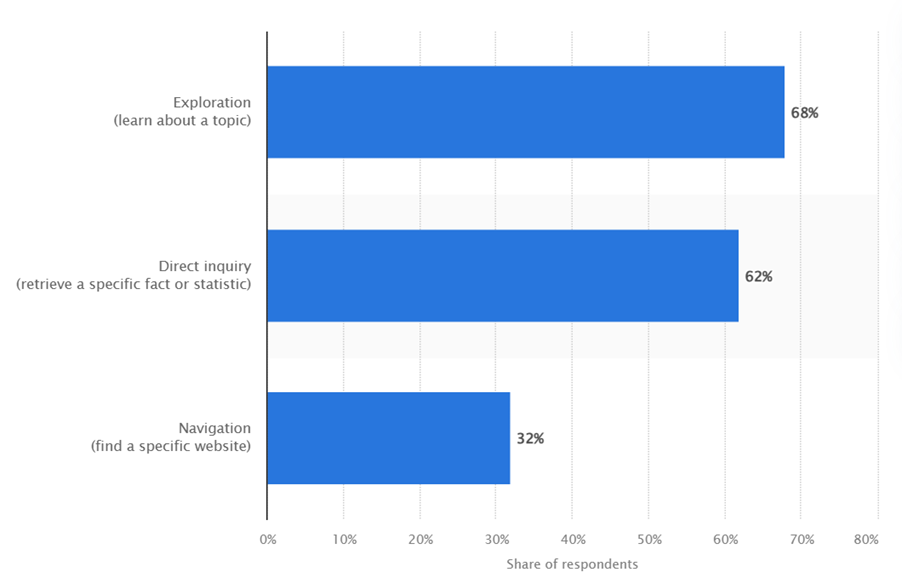
Artificial intelligence-powered search usage among adults in the United States in 2024, by search type AI-powered search types among U.S. adults 2024| Statista
It’s tempting to frame this as a battle between two channels. In reality, they are just at different points in the same journey.
A typical path now looks something like this:
| Stage | User Behaviour | Channel |
| Discovery | “What’s the best way to improve website traffic?” | AI |
| Research | “SEO agency Sheffield” | Search |
| Decision | Reviewing services, comparing providers | Website |
AI helps users get started. It removes the blank page problem. But once intent becomes clearer, behaviour shifts.
Search becomes more specific and narrows things down. Queries become even more direct. Users start looking for options they can evaluate and act on.
This means that Search Engine Optimisation is still really important. If anything, AI is making search traffic more valuable. By the time a user gets to Google, they’re often further along in their thinking. In the past they might have been at the browsing stage on Google but now, they’re more likely narrowing down ideas they’ve been given by AI.
Though it means fewer random clicks, the ones that do happen come with stronger intent.
Why Organic Traffic Still Converts Better
One of the biggest misconceptions is that all traffic is equal. It isn’t. Traffic from search tends to convert better because it shows intent more clearly. Users are actively looking for something. They’re not just generally curious.
Compare these two examples:
- “What does an SEO agency do?”
- “SEO agency Sheffield”
The first is exploratory. The second is actionable.
Search captures that second type of query extremely well. People typing in this type of search are already ready to compare, evaluate and make a decision on which agency to hire.
AI, on the other hand, often captures earlier-stage thinking. It answers questions, but it doesn’t always move users towards action. In the example above, AI would give a detailed response to “what does an SEO agency do” but wouldn’t direct you to researching ones you might want to use.
So you can now see why organic traffic remains so valuable—it’s not just about volume, relevance matters.
There’s also a level of control with search that AI doesn’t have. Businesses can:
- Optimise pages for specific queries.
- Structure content for clarity.
- Target high-intent keywords.
With AI, visibility is less predictable. You can influence it, but you can’t control it in the same way.
A simple way to think about it is that AI answers questions, search solves problems. And when someone is ready to solve a problem, search is still where they go.
How to Optimise for Both Search and AI
You don’t have to choose one over the other. The strongest strategies now account for both. The good news is that the fundamentals overlap quite well.
1. Create clear, structured content
Content that’s easy to read performs better everywhere. That includes both search engines and AI tools. Clear headings, short paragraphs and logical flow help.
2. Answer questions directly
AI tools favour content that gets to the point quickly. The same is true for search. Pages that clearly answer user queries tend to perform better.
3. Build topical authority
Covering a subject in depth increases your visibility across both channels. It signals expertise, which improves rankings and makes content more likely to be referenced. Being an expert in your field is great for AI and search engines alike.
4. Focus on real expertise
Generic content is easier to ignore. First-hand insight, examples and clear opinions stand out more. This matters for both search performance and AI visibility.
5. Keep content updated
Outdated information loses trust quickly. Regular updates maintain your rankings. They make sure your content is still relevant when AI tools find it.
If you’re looking to build or refine this approach, a strong SEO strategy should now consider both how content ranks and how it gets used. That’s something that we can help you with in our dedicated strategy sessions.
Key Terms at a Glance
| Term | What It Means in Practice |
| Traditional SEO | Optimising your website to rank in search engines like Google using keywords, content and links. |
| AI SEO | Structuring content so it can appear in AI-generated answers from tools like ChatGPT and AI Overviews. |
| Keywords vs Prompts | Keywords are short search queries. Prompts are longer, conversational questions used in AI tools |
| Query Intent | The reason behind a search. This is whether someone is researching, comparing or ready to take action. |
| AI-Friendly Content | Content written clearly and directly so AI tools can extract and reuse it easily. |
| Backlinks vs Brand Mentions | Search relies heavily on backlinks. AI also values brand mentions, even without links. |
| AI Visibility Metrics | New measures like AI mentions, citations and share of voice that track presence in AI tools. |
What This Means for Your SEO Strategy in 2026
SEO isn’t shrinking like some think it is. It’s even becoming more important in a slightly different way.
It used to be just about ranking on a results page. Now, though, you need to be visible across multiple touchpoints, and this includes AI-generated responses.
Content needs to do more than just exist. It needs to be:
- Clear enough to extract.
- Credible enough to trust.
- Useful enough to reference.
When businesses focus purely on keywords without much thought on quality, they’ll struggle with SEO. Remember the days of spamming keywords into random content to help you rank higher? It’s a bit like that. Chasing AI trends without a solid search foundation is the new keyword stuffing. It used to work because search engine algorithms relied on keyword density to determine relevance. The more a keyword appeared, the more relevant the page looked to the search engine. Now, though, search engines look at the quality and depth of the content as well as how satisfied users are with it.
The strongest approach is balanced. Search is still the core driver of traffic and conversions. AI works with it, determining how users get there.
Where Businesses Get This Wrong
A lot of businesses are reacting to AI in ways that don’t hold up long term.
Common mistakes include:
- Shifting too much focus away from SEO.
- Producing large volumes of low-quality AI-generated content.
- Ignoring user intent in favour of trends.
- Expecting AI visibility without building authority.
The result is usually the same. Traffic becomes less consistent. Conversions drop. It’s not an AI issue, it how you’re using it that’s the problem.
AI works best as part of a bigger picture and strategy. It can support content creation, speed up research and improve efficiency. But with all that you still need clear positioning, structured content and good fundamentals. Business that perform better, recognise this subtlety.
What it Looks Like in Practice
It’s one thing to understand it theoretically, but it’s better to see how this plays out in real behaviour.
Here’s an example. A business owner wants to improve website traffic. A few years ago, he might have gone straight to Google and search something like “how to get more website traffic.” He might then click through a few articles, skim read and make mental notes.
Now, though, this sort of query is more likely something you’d use AI for. You ask a broader question and get a structured response outlining different approaches. It’s quicker and easier to digest.
Then, though, the business owner tends to go back to search. They look for specific services, examples or agencies. They look at options available, read reviews and check credibility. So, what we see is that search still drives the major decision-making.
Businesses need to have content that supports both stages. You need to be helpful enough to appear early but also be visible enough to be chosen later on.
Final Thoughts: It’s Not Search vs AI, It’s Search and AI
The idea that search is being replaced doesn’t match how people actually behave. Decisions need search. Users are comparing options, checking information and taking action through search. All AI has done is change the start of this process. It’s made things easier to explore and understand. But it hasn’t removed the need to search.
If anything, it’s made search traffic more valuable.
The opportunity now is to corroborate both. You need to create content that supports exploration, ranks in search and builds trust across both channels.
If you want to understand how that looks for your business, or where your current strategy might need adjusting, you can always get in touch with the team.
The landscape has changed but the fundamentals are still very much in place.