Search is bigger than it ever has been. Google processes around 189,800 searches per second, adding up to more than 5.9 trillion per year. It has roughly 5.01 billion users worldwide and close to a 90% share of the global search market. It’s no surprise then that SEO has become more complex, more competitive and more commercially important.
SEO platforms have responded by becoming more powerful. They crawl faster, track more signals, surface more data and promise clearer insight. At the same time, they’ve become harder to use well. Many businesses are paying for powerful all-in-one platforms without fully understanding what they’re designed to do. Or which parts actually matter to them.
There’s a growing gap between feature depth and real-world usage. Most teams rely on a small slice of what their SEO platform offers, while the rest goes untouched. “All-in-one” has become a buying signal rather than a strategic decision. Tools are chosen for reassurance, not fit.

Image source: How Many Google Searches Per Day [New 2026 Data]
Why SEO Platforms Have Become Strategic Infrastructure
SEO platforms aren’t the passive tools that you might have thought they were. They now sit at the centre of how SEO work is planned, prioritised and judged. That change has happened because search itself has become more complex.
Algorithms change constantly. User experience signals matter. Technical standards are higher. Intent is harder to interpret at scale. Managing all of that without structured systems isn’t realistic.
As marketing budgets continue to move online, with 72% of marketers now allocating the majority of spend to digital channels, SEO platforms have taken on a bigger role. They aren’t data collectors. They’re decision-makers. What appears on a dashboard quickly becomes “what matters”, even when that metric is only part of the picture.
From Specialist Tools to All-in-One Platforms
SEO didn’t start out with all-in-one platforms. Most teams built their stacks gradually. They added specialist tools as new needs emerged. One for keywords. Another for links. Something else for site audits or reporting. It worked, up to a point.
As SEO matured, those fragmented stacks became a problem:
- Data lived in different places.
- Metrics didn’t always line up.
- Reporting took longer than the work itself.
All-in-one platforms came about to fix that workflow friction. It simply brought all of the functions under one roof.
That consolidation improved efficiency, but it also introduced a trade-off. Specialist tools often go deeper into one area. All-in-one platforms prioritise breadth, integration and speed. For many businesses, that’s a sensible exchange. For others, it can feel limiting.
What consolidation didn’t solve was strategy. Bringing tools together makes SEO easier to manage, not easier to decide. Platforms can streamline execution, but they still need clear direction to be used well.
| Fragmented SEO stack | All-in-one platform |
| Deep, specialist features | Broader, integrated view |
| Disconnected data | Centralised reporting |
| Slower workflows | Faster decision cycles |
| Higher learning curve | Easier day-to-day use |
Hidden Capability and the Under-Use Problem
One of the quiet issues with modern SEO platforms is not lack of capability, but excess of it. Industry-wide MarTech research consistently shows that businesses typically use well under half of the features available in the tools they pay for. In some cases, it’s closer to a quarter. The rest isn’t used. This isn’t because teams are failing, it’s more because the platforms have changed and added features faster than the people using them.
Having more features doesn’t automatically lead to better outcomes. They often do the opposite. As platforms get bigger, they introduce more metrics. This complexity can dilute focus. Teams can end up spending more time analysing data than acting on it.
SEO tools also encourage certain behaviours. What’s easiest to see gets prioritised. What’s harder to measure is often ignored. That doesn’t mean the platform is wrong, but it does mean it shapes decisions in subtle ways.
Unused functionality is usually a matter of misalignment, not failure. The problem isn’t that teams aren’t using everything. It’s that many platforms are bought without a clear idea of what should matter most.
What “All-in-One” Actually Means
“All-in-one” is one of the most overused labels in SEO software. In practice, it doesn’t mean that every platform does everything equally well. It usually means that a shared set of core features lives under one roof: site crawling, keyword research, rank tracking, backlink analysis and reporting. Most established platforms cover these basics reliably.
Where they differ is in emphasis. Some are built around competitive intelligence and scale. Others are more focused on usability and guidance. SEMrush and Ahrefs, for example, are designed for teams that already know what questions they want to ask. Platforms like Moz tend to focus more on clarity, education and accessibility.
This is why platform choice should reflect maturity, not ambition. Buying enterprise-level software doesn’t make an SEO strategy more sophisticated if the team isn’t ready to use it properly. Things are often under-used if they’re complex.
It’s also worth remembering that SEO isn’t just a set of tools. Platforms support human decisions. Used well, they sharpen our focus. Used poorly, they’re noisy and distracting. At Key Principles, our SEO experts can help you decide which tools are best for your business’s individual SEO needs.
Popular All-in-One SEO Platforms
At some point, most readers will want to know what these platforms actually look like in practice. While no single tool is right for everyone, there are a few established names that tend to appear again and again, largely because they reflect different ways of approaching SEO.
Some platforms lean heavily into competitive intelligence and scale. Tools like SEMrush and Ahrefs are often used by agencies and larger teams. They’re great for those that need deep datasets, strong competitor insights and high usage limits. They’re powerful, but they also assume a certain level of SEO maturity. Without that, they can feel overwhelming or underused.
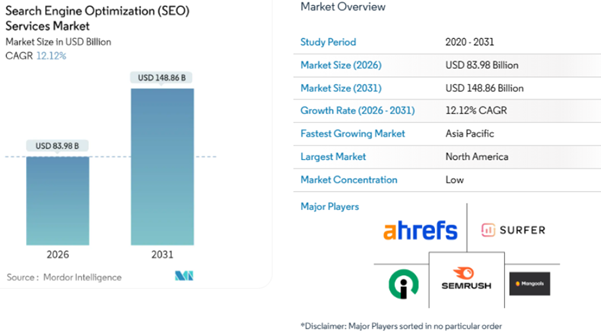
Image source: Mordor Intelligence Research & Advisory. https://www.mordorintelligence.com/industry-reports/seo-market
Others are more focused on usability and accessibility. Moz, for example, appeals to smaller teams and in-house marketers. People who want clear guidance, reliable fundamentals and a gentler learning curve. The associated downside is usually depth and speed, rather than breadth.
There’s also a growing middle ground. Platforms such as SE Ranking and Serpstat aim to balance cost, coverage and reporting. It makes them attractive to SMBs and agencies that care about value as much as capability.
What matters most isn’t the logo. It’s whether the platform matches how your team actually works, and whether its strengths align with what you need SEO to do.
The Top Five All-in-One SEO Platforms
Most businesses gravitate towards a handful of well-known names. These are widely used not because they do everything equally well, but because each one reflects a different idea on how SEO should be planned, measured and managed.
Ahrefs
Ahrefs has built its reputation on data depth. This is especially true for backlinks and site authority. It’s widely trusted for link analysis, historical comparisons and identifying where competitors are gaining ground.
Many experienced SEOs use it as a core research and auditing tool rather than an end-to-end workflow platform. It’s less focused on content processes and reporting but for experienced teams that care deeply about a site’s technical health and reliable data keyword and backlinking data, it’s a go-to.
SEMrush
SEMrush is another SEO tool designed for larger teams and more experienced SEOs. It’s an all in on platform that also has strong data depth but perhaps slightly less than Ahrefs. SEMrush’s strength lies in how much competitive and market-level insight it can surface, from keyword opportunities to visibility gaps across entire sectors.
Its breadth is why it’s popular with agencies and larger in-house teams. This also means the platform works best when users already know what they’re looking for. Without clear priorities, it’s easy to spend time exploring data rather than acting on it.
Moz
Moz has a more user-friendly approach to SEO. Its tools are designed to explain what’s happening and why and provides a more educational workflow for less experienced SEOs. This is why in-house teams and smaller businesses without specialist SEO roles like it. Its datasets aren’t as large as some competitors. Yet, it prioritises clarity and education. It’s a worthwhile trade-off for businesses building up SEO teams internally.
SE Ranking
This platform is often chosen for its balance of coverage and cost. It handles core SEO tasks well, with particular strengths in rank tracking and client-ready reporting. Agencies and SMBs value its practicality and predictability. However, it doesn’t offer the same depth of data as enterprise platforms.
Serpstat
Serpstat sells itself as an accessible all-rounder. It offers keyword research, clustering and basic competitor analysis in a familiar interface, making it easy to adopt. It lacks some advanced features but it’s a sensible option where budgets are tighter. And when simplicity is a priority.
How They Compare
| Platform | Best known for | Strengths | Trade-offs | Best fit for |
| Ahrefs | Keyword and backlink data and technical analysis | Large keyword database, backlink analysis, strong technical audits | Premium pricing, limited content tools, steep learning curve | Data driven teams and advanced SEOs |
| SEMrush | Competitive intelligence and scale | Large keyword database, strong competitor research, broad feature set | Premium pricing, steep learning curve | Agencies. In-house SEO teams. Enterprise environments |
| Moz | Usability and guidance | Intuitive interface, clear metrics, strong learning resources | Smaller datasets, lighter competitor analysis | Freelancers, SMBs, in-house beginners |
| SE Ranking | Reporting and value | Affordable pricing, solid rank tracking, client-friendly reports | Less depth than enterprise tools | SMBs and agencies focused on reporting |
| Serpstat | Cost-effective all-round coverage | Wide feature range, keyword clustering, PPC insights | Smaller data sets, fewer advanced features | Budget-conscious teams and freelancers |
Matching Platforms to Business Reality
There’s no one “best” platform. One business’s best is completely wrong for another. Context is more important than reputation or feature lists.
- Smaller businesses and SMEs usually need focus and clarity. They benefit from platforms that surface priorities clearly, support content planning and don’t require specialist knowledge to interpret.
- Enterprise organisations often need scale, deeper data and the ability to support multiple sites, markets and stakeholders at once. Those needs come with added complexity, and higher costs.
Workflow matters just as much:
- In-house teams tend to value usability and integration with wider marketing activity.
- Agencies often prioritise reporting, flexibility and the ability to switch context quickly between clients.
A platform that feels intuitive internally may fall short in a client-facing environment, and vice versa.
SEO priorities also differ:
- Content-led strategies lean heavily on keyword intent and optimisation workflows.
- Technical-led approaches need robust crawling and diagnostics.
This is why platform choice should start with goals, not tools. If you need support, a focused strategy session helps avoid costly mismatches that no amount of software can fix.
Common Mistakes When Choosing SEO Platforms
It’s a fairly common mistake to buy a platform before you know what success looks like. Tools are often chosen on reputation or feature lists. Instead, the focus needs to be on the outcomes the business is trying to achieve. Without clear goals, even the best software ends up under-used.
Another issue is confusing visibility with impact. Rankings, dashboards and alerts can provide a sense of progress. However, these don’t always translate into meaningful results. It’s easy to spend time monitoring movement without understanding it. Is it driving traffic, leads or revenue?
Many businesses also fall into platform-led thinking. The tool starts to dictate what gets worked on. This is often because it’s visible or easy to measure. It ends up that, over time, strategy bends to fit the software when it should really be the other way around.
Over-investing too early is part of the same issue. Buying enterprise-level platforms before teams, processes or priorities are in place makes things usually adds complexity, not capability. Strategy should come first. Tools should follow.
Final Thoughts: SEO Platforms Are Part of a Wider Marketing Strategy
SEO platforms work best when they’re treated as part of a wider marketing strategy, not as the strategy itself. They surface insight, highlight patterns and flag issues, but they don’t decide what matters most. That responsibility still sits with people.
The strongest results come when tools, teams and goals are aligned. Platforms support decisions by providing structure and evidence, but they can’t replace judgment. Without a clear framework, even the most advanced software can pull focus in the wrong direction, rewarding activity rather than impact.
This is where strategy provides the filter that platforms lack. When SEO is aligned with content, UX and commercial objectives, tools become far more effective and far less noisy. Without that alignment, dashboards multiply while clarity disappears.
Tools should create clarity. If they create noise, something is misaligned.
If you want help aligning your SEO platform with real business goals, get in touch to discuss how your current setup is supporting, or holding back, your wider marketing performance.