Whilst keyword research tools are essential for planning and managing both SEO and PPC campaigns, not many people are aware of the capabilities that they have for making wider business decisions.

If you’re a Product Manager looking to pitch an entirely new product, search data can help you in deciding if there’s a demand for it.
By analysing the popular search terms that consumers are searching for, you can gain invaluable insights into what customers are looking for, helping you not only in product development but also with creating marketing communications and reputation management strategies that fit in perfectly with a current trend.
Potential use cases for keyword tools:
- A start-up launching a new-to-market product.
- Established businesses looking to extend their product range or diversify into new related markets or products.
- Brands looking to appeal to a trend or concern in their marketing communications.
- Managing the reputation and sentiment of a business.
- Analysing public perceptions of competitors, finding ways to differentiate.
- Deciding on product names or even names of books.
The free keyword tools we’ll be using are:
Want to learn the best practices for using keyword tools for planning digital marketing campaigns? We’ve created an in-depth blog for using keyword tools for SEO strategy.
Keyword tools for product development

It’s all well and good to have an idea for a product, but if no one is searching for it (or a similar product) it’s likely that the product will be difficult to position.
With Google being the largest search engine, and the go-to place for people to learn about new products, using tools to analyse who’s searching, where they’re searching and what they’re searching for provides invaluable insights into what they want from a product.
Here are some examples of how you could apply keyword research to your new product development:
- Finding in-demand products and product features.
- Using search statistics to support your boardroom pitch.
- Look at search data and commonly asked questions to identify potential products names and/or positioning.
Example 1 – Finding desirable service features
This technique works particularly well if you’re selling a product or service that’s a particularly important purchase (Eg: a conservatory on a house).
By entering ‘conservatory’ into Google Trends, you’ll get the following:
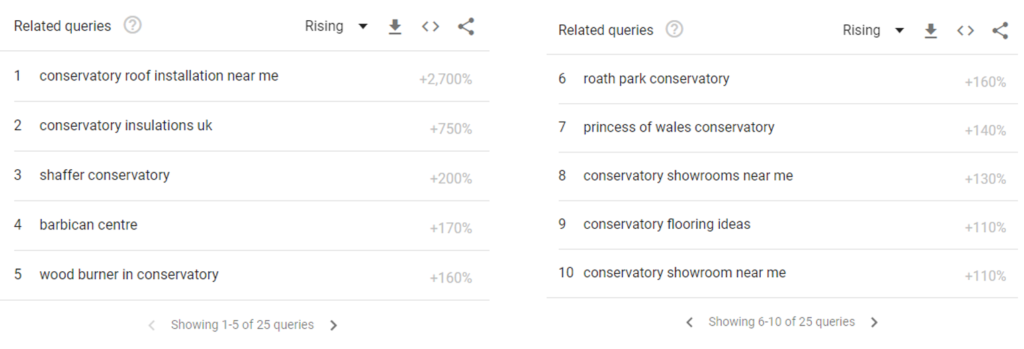
Based on this data, you could say that people who are searching for conservatories are also interested in options for getting them insulated, and they may want further inspiration on the flooring options available to them.
This then opens up the opportunity for a business selling conservatories to consider also offering flooring solutions and insulation (or partnering with someone who does).
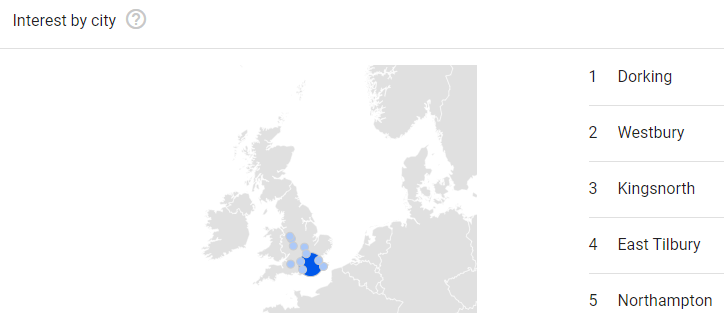
Google Trends also allows you to view the search volumes over a time period for specific keywords, and even splits them into geographic locations, allowing you to analyse where the topic is most popular.
Example 2 – Pitching or launching a new product

We’re well aware that the majority of business decisions are made based on cold hard facts and statistics (or at least they should be!). So if your department or company is looking to pitch or launch a new product, ensure you’re prepared with plenty of data to justify how the product matches the demand.
Let’s say you’re pitching an entirely new product (such as a VR Design App to compliment your current product range, allowing customers to view your products in VR on their mobile devices).
By using Google’s Keyword Planner and clicking on ‘get search volume and forecasts’, you can add in some general keywords that are related to your new product or service.
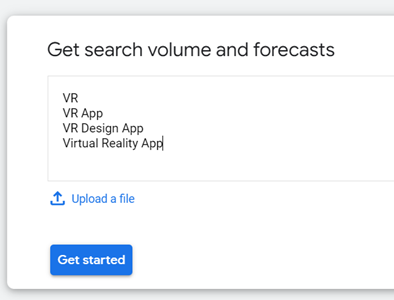
By clicking ‘get started’, you’ll be able to select a country you want to receive search data from. The data provided includes average monthly searches, the percentage increase (or decrease) in the number of searches (both yearly and monthly), the level of competitiveness, and approximately how much it would cost per click if you were to run the keyword in a Google Ads campaign (which also gives an idea of competitiveness).
You’ll then be presented with search data for each keyword, giving you an idea into how popular the topic of your product or service is, and whether it’s increasing or decreasing in popularity.
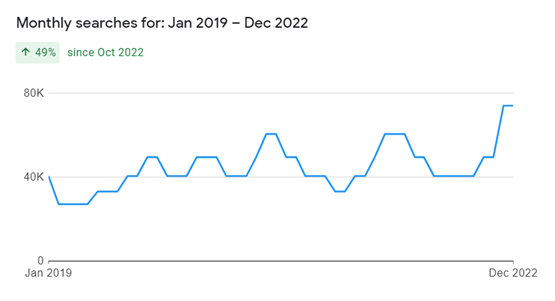
Using the data in Keyword Planner can add justification and competitive metrics to the data you’ve found in Google Trends.
Presenting to the board room
So, from this data, you could say that the monthly searches for ‘VR’ have nearly doubled since January 2019, and it’s been on an upward trend since then.
Obviously, this data isn’t solely enough to make a significant business decision, but it can certainly help with justifying the suitability of a new product within a market.
Launching a new product and want the product to appear as highly in Google’s search engine rankings as possible? Request a free SEO consultation from our friendly team of specialists!
Use cases for marketing communications

As well as recognising a demand, keyword tools are incredibly valuable for recognising trends, concerns, and changes in consumer behaviors.
Here are some examples of how you could apply keyword research to your marketing communications:
- Recognising important questions to answer in your advertising
(such as the common questions and problems that people have when buying your product/service). - Listening to what people think about your company and its competitors
(This usually works best for mid to large companies, but it allows you to adjust your marketing communications to overcome negative ideas associated with your brand).
Recognising important questions to answer using Answer the Public
You can get a wide array of information on the types of questions people have about your service, not only allowing you to answer them on your website (boosting your SEO), but also building them into your marketing campaigns.
For example, here are the most commonly asked ‘will’ questions for ‘Car Insurance’:

So in this case, if you’re a car insurance broker that covers repairs, this data suggests that adding this information to your marketing communications is likely to answer a lot of people’s questions, thus making them more likely to buy from you.
Listening to what people think about your company and your competitors
As mentioned in the previous section, Answer the Public is an excellent tool for listening to the questions that customers might have about a particular topic.
Not only this, but it’s also superb for analysing the pubic perception around your brand and your competitors, allowing you to:
- Rectify negative public perceptions of your company.
- Find negative perceptions of your competitors to help differentiate your brand.
For example, by entering ‘Ryanair’ into Answer the Public, you get a whole host of regularly asked questions and concerns that searchers have for the brand:
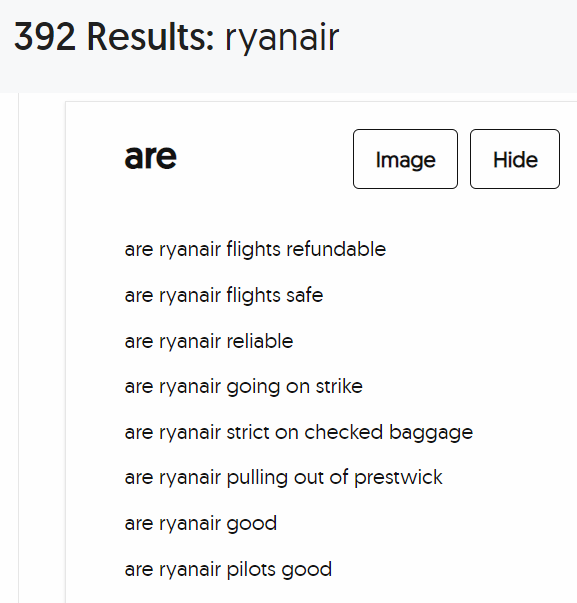
If you were a competitor to Ryanair, you could differentiate your brand as having a transparent refund policy, super-safe flights and possibly even a generous baggage policy as these are questions that people have about your competitor.
Now, of course, most businesspeople aren’t in the travel industry, but this strategy could be applied to any industry and any business. We only used Ryanair as they’re a great example of a company with a rather divisive public image!

Get notified of news and trends based around a particular topic with Google Alerts
In addition to Answer the Public, with Google Alerts you can monitor the content that’s being posted about your company or its competitors in real-time. Whilst Answer the Public can be used for planning reputation strategies, Google Alerts can be used to react to trends and public reactions in real-time.
Conclusion

Despite usually only being used for SEO and PPC, keyword research can be applied to multiple areas of marketing, from product development to reputation management.
In this article, we’ve found that keyword tools can be used to help in market research for new product development, justifying business decisions with data, and informing marketing communications plans. Not only this, but these tools are excellent at gaining an insight into what people think of your company and your competitors, allowing you to position your brand favorably when compared to the concerns people have over your completion.
Creating a marketing strategy?
Our team has decades of experience in implementing marketing strategies for a diverse array of industries. Contact us for more information on how we might be able to help with your marketing strategy.