
Everyone is talking about AI-generated content. Some people are excited about it. Others are convinced it’s ruining the internet. Realistically, it’s probably somewhere in the middle.
Recent research suggests that nearly half of all online articles are now primarily AI-generated. That figure briefly climbed above 50% in late 2025 before settling back to around half of all published content. It’s a remarkable statistic but it’s also probably the least interesting part of the story.
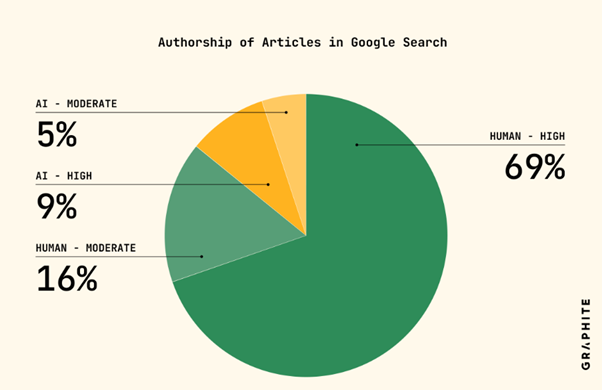
Image source: AI Content In Search & LLMs
The more important question is this:
If everyone can create content faster than ever before, how do you make your content worth reading?
That’s where you have a real opportunity. For a while, many businesses viewed AI as a shortcut. Generate more articles. Publish more frequently. Cover more keywords. Win more traffic. It seemed simple.
Except it hasn’t really worked out that way. If anything, the rise of AI-generated content has made standing out harder. The internet is becoming increasingly crowded with articles that look professional and sound professional. They say largely the same things. An AI tool can knock out a long, detailed, largely accurate piece in seconds.
That creates a problem for bloggers. Or you could see it as creating an opportunity. Let’s be glass half full for a minute. While AI has made content creation easier, what it hasn’t done is made expertise, originality or genuine insight any easier to replicate. It’s essentially regurgitating what it’s learned that’s already out there.
Originality, expertise and genuine insight may now be more valuable than ever.
AI has changed content creation forever
There is no point pretending otherwise. AI has fundamentally changed how content gets produced. Before ChatGPT arrived in late 2022, creating a blog article involved a fair amount of work. Research gathering. Draft writing. Subject matter experts consulting. The whole process could take days.
Now, a first draft can appear in under a minute:
- Research can be summarised instantly.
- Outlines can be generated automatically.
- Content calendars can be built in an afternoon.
It’s easy to see why businesses wanted it and took to it so quickly. The numbers tell the story.
Research analysing more than 55,000 online articles found that AI-generated publishing exploded after ChatGPT launched. Within just twelve months, AI-generated content accounted for more than a third of all articles published. By early 2026, that figure had reached almost 50%.
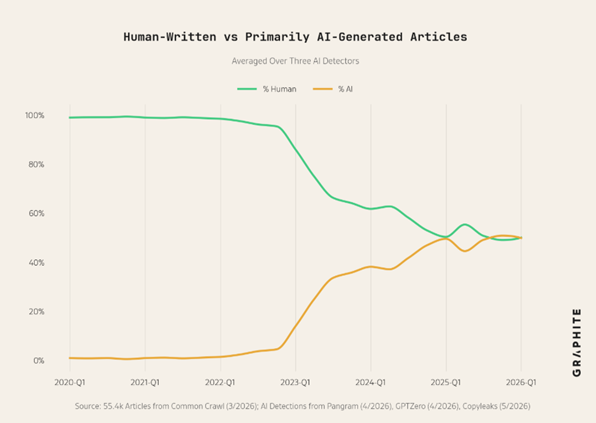
Image source: AI Now Writes as Many Online Articles as Humans Do
The appeal is obvious. AI can help with:
- Research.
- Outlines.
- Draft creation.
- Content ideation.
- Editing.
- Repurposing content.
It can save enormous amounts of time.
The problem is that every other business has access to exactly the same tools available to them. ChatGPT is free or you can get basic packages for better quality responses from as little as £20 per month.
When everyone has this same advantage, it’s not an advantage anymore.
More content doesn’t automatically mean better content
Remember when you used to be able to fill a text with keywords and it helped ranking? It doesn’t anymore. The same can be said for churning out loads of content in the hope having more means getting more in return.
The internet has more content than it ever has had. In 2025, 181 zettabytes of data were created, that’s 1 trillion GB. This doesn’t mean the internet has more useful content.
Search for almost any common marketing topic and you’ll find hundreds of articles covering exactly the same ground:
- SEO tips.
- Email marketing advice.
- How Google Ads work.
- Social media best practices.
The wording changes. The formatting changes. The advice often doesn’t. Many articles are perfectly accurate. There’s nothing technically wrong with them. They’re just forgettable.
This is one of the biggest challenges as a business owner. It’s not having a lack of content, it’s that it’s not distinct enough. AI is incredibly good at producing content that sits somewhere around the average of everything already written on a topic. It’s how it works. It looks at what’s out there, finds common patterns, reproduces common recommendations and uses common structures.
It’s all much of a muchness as a result. The growing sea of content looks polished but it struggles to say anything genuinely new or innovative.
People aren’t tired of AI content. They’re tired of generic content
One of the most interesting misconceptions around AI-generated content is the idea that readers can always tell when something has been written by AI. Most can’t.
To the untrained eye, it’s not easy to spot. It doesn’t need to be spotted for it to be ineffective and put people off. People who don’t engage with it aren’t doing so because it’s written by AI, they’re often reacting to something else entirely. It’s the generic content.
You’ve probably experienced it yourself. You click on an article, the style feels familiar, so does the introduction. The examples are all ones you’ve seen before. The advice you could probably guess at. By the time you get to the conclusion (if you even get that far), you’ve not learned anything new or very little new at least. It doesn’t send alarm bells that ring out “WRITTEN BY AI.” AI might not have written it after all, it could have been a generic content writer.
The problem arises because nothing in the article is new. This is where many businesses go wrong with SEO. They focus entirely on producing content and spend far less time thinking about whether the content deserves attention in the first place.
It sounds harsh but it’s becoming more and more important.
The real competition isn’t AI. It’s every other business publishing the same article as you.
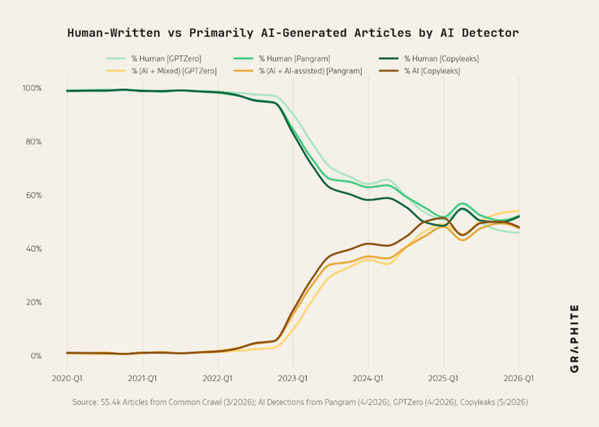
Image source: AI Now Writes as Many Online Articles as Humans Do
What Google actually cares about
Whenever AI-generated content is discussed, the conversation eventually turns to Google. Will Google penalise AI content? Does Google know if content is AI-generated? Will AI-written articles rank?
Google has consistently focused on a different question altogether. Many businesses refute AI-generated content because they think Google hates it. It doesn’t. Google concentrates on whether or not the content is useful. That’s what matters.
Google has repeatedly stated that content should be created primarily for people, not search engines. The method used to create it is secondary.
A poor article written entirely by a human is still a poor article. A genuinely useful article that uses AI during the drafting process can still provide value.
What Google ultimately wants is content that shows E-E-A-T:
- Experience.
- Expertise.
- Authority.
- Trustworthiness.
After all, if anyone can create a 1,500-word article in minutes, search engines need better ways to identify which content deserves visibility. Quality matters.
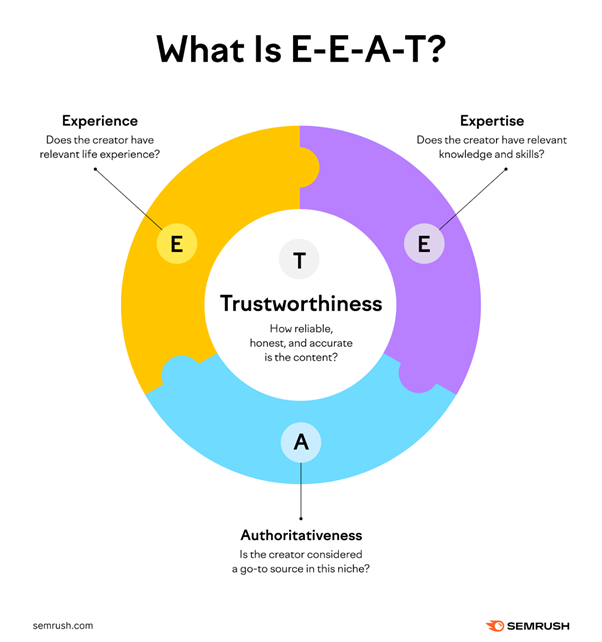
Image source: Google E-E-A-T: What It Is & How It Affects SEO
Expertise is more valuable
This is perhaps the biggest irony of the AI content boom. Many people assumed AI would reduce the value of expertise. The opposite may be happening.
From a reader’s perspective:
If hundreds of websites can instantly generate a basic article about SEO, what makes one worth reading?
Usually, it’s evidence, experience, insight and proof that the writer understands the subject beyond what can be found in a search result.
There is a big difference between: “Conversion tracking is important” and “We recently reduced cost per acquisition by 27% after rebuilding a client’s conversion tracking setup.” The second example feels more valuable because it comes from real-world experience. It tells us something. We get the context and know there’s expertise behind it.
AI can explain what conversion tracking is, but it cannot run a campaign. It cannot learn lessons from client projects. It cannot develop opinions through experience.
Businesses still have an advantage, but many aren’t using nearly enough.
The things AI still struggles to replicate
AI tools are improving quickly. Some tasks that seemed impossible two years ago are now routine. Human expertise can’t be replaced everywhere though:
Here’s a simple comparison:
| AI can help with | Humans still excel at |
| Research | Experience |
| Drafting | Judgement |
| Summarising information | Original thinking |
| Scaling production | Creativity |
| Structure | Nuance |
Experience is perhaps the biggest gap. AI can describe an experience but it cannot actually have one. The same applies to judgement. Marketing doesn’t operate in black and white. There are trade-offs, exceptions and commercial realities that influence decision-making. Experienced professionals understand those nuances because they’ve lived them. Key Principles can help you with this in one of our dedicated strategy sessions.
Let’s discuss original thinking. Most AI systems work because they recognise patterns. Business can challenge those patterns to stand out. Genuinely interesting content comes from patterns being challenged.
Be original and beat the competition
A few years ago, simply useful content could be enough to get the reach you needed. Useful is today’s basic starting point. Businesses that do the best, do more than that. They add a unique take and bring in their own perspective in the form of original research, real projects being talked about and insights that their competitors can’t replicate.
We’re not talking groundbreaking research and lifechanging statistics. Originality is simpler: sharing lessons learned, explaining mistakes, discussing trends, talking about customer challenges and offering an informed opinion (like we do in our strategy sessions).
This makes the content feel like there’s a human element to it. And it’s harder to copy – win-win!
How to make your blog stand out in 2026
Standing out doesn’t necessarily require a bigger content budget. Thankfully!
It just needs a different mindset. Here are some ways that we’ve found give better results:
1. Share real experiences
One of the best ways to differentiate content is to draw on your own genuine experience.
What have you learned, what surprised you, what challenges have you faced?
These insights often provide more value than generic advice.
2. Use real examples
Examples build trust. Talk about your clients, use them as examples of how you’ve been successful. They help readers understand concepts and demonstrate expertise at the same time.
3. Publish original research
Data is one of the strongest forms of content differentiation. Even small studies or industry observations can create something genuinely unique. You could ask your mailing list a few simple questions and collate the data. Being able to say things like “our customers say that X is more important than Y” help.
4. Develop a recognisable voice
Many AI-generated articles sound interchangeable with one another. Write your blog in our own style. Be distinctive so you’re easier to remember. Don’t add a different tone or style from one blog to another because it won’t sound like “you.”
5. Focus on solving problems
The best content starts with audience needs rather than keyword opportunities. Answer the questions that customers are asking. Solve the problems they’re trying to solve. The rankings often follow.
Why this is actually good news
It’s easy to look at the growth of AI-generated content and assume content marketing has become more difficult. In some ways, it has. We’ve said already how competition is certainly increasing, how publishing content is easier than ever and how the volume of information online continues to grow. But this is only half of it.
The other half is that genuinely useful content now has more opportunities to stand out.
Think about it. If half the internet is publishing increasingly similar content, what happens when a business publishes something genuinely insightful? It becomes easier to notice.
Right now, standing out might be the biggest opportunity in SEO.
If you’d like help creating content that attracts the right audience and supports your wider SEO strategy, contact the Key Principles team to discuss your goals.