
October 2025 is here, and with it, Google’s new EU political ads policy is now fully in force. This is more than just another update to advertising rules. This time, it’s a sweeping ban that has changed how campaigns run across Europe.
As of late September, Google confirmed that any campaign declared as containing EU political ads will no longer serve in the EU. This means advertisers now face a stark choice: declare political content correctly, or risk immediate suspension.
The rules have been driven by EU Regulation 2024/900, which introduced strict boundaries around political advertising and expanded the definition of who counts as a political actor. Campaigns that once seemed compliant may already have been paused. Many advertisers are now scrambling to audit their accounts.
- If you’re unsure whether your campaigns could fall under the new rules, our team can help. Book a strategy session and get a full compliance review before your ads are affected further.
Policy Overview: Google’s EU Political Ads Ban
At the end of September, Google stopped serving political ads in the EU. This applies to campaigns across Google Ads, YouTube, Display and other Google-owned platforms.
The following categories are now banned:
- Ads by, for, or on behalf of a political actor, unless the message is purely private or commercial.
- Ads designed to influence political outcomes. This includes elections, referendums, legislative decisions or regulatory processes at EU, national, regional or local level.
Who counts as a “political actor”?
The EU Regulation 2024/900 sets a broad scope:
- Political parties and their affiliates.
- Political alliances and European political parties.
- Current officeholders and candidates for elected office at any level.
- Individuals seeking leadership roles within a party.
- Members of EU institutions (excluding the Court of Justice, ECB and Court of Auditors).
- Campaign organisations formed to influence election or referendum results.
- Any organisation or individual acting on behalf of political entities, promoting their political goals.
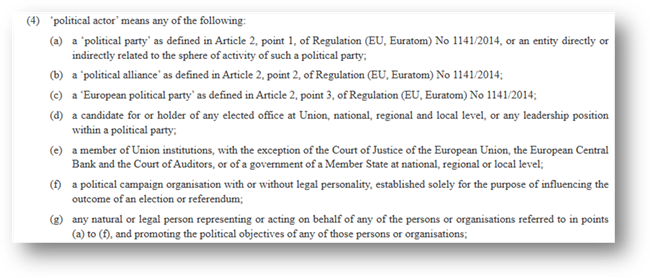
Definition of a political actor according to EU Regulation 2024/900.
Source: https://eur-lex.europa.eu/eli/reg/2024/900/oj/eng#:~:text=political%20actor%E2%80%99%20means,persons%20or%20organisations%3B
Examples of what isn’t allowed
- Ads supporting or opposing political parties, coalitions or candidates.
- Ads tied to a referendum campaign. Or ones that encourage voting behaviour.
- Ads that indirectly promote a political outcome by criticising, endorsing or highlighting political issues connected to elections.
What is allowed?
There are limited exemptions:
- Official election participation information. This means information telling people where to vote or giving candidate announcements. This must come from official EU or Member State sources. They can promote participation in referenda or elections, or announce candidacies or a referendum question to answer.
- Public communications from authorities. So long as they are informational rather than persuasive.
Advertisers must apply directly to Google for approval before they run content in these categories. Each account needs to submit a separate application. Agencies can’t apply once on behalf of multiple clients.
UK Election Ads
Election ads that are allowed must target their ads only by:
- Geographic location (not radius around a location).
- Age.
- Gender.
- Contextual targeting (e.g., ad placements, keywords against sites, topics, apps, pages and videos).
Most of the time, there will be an automatically generated “Paid for by” disclosure.
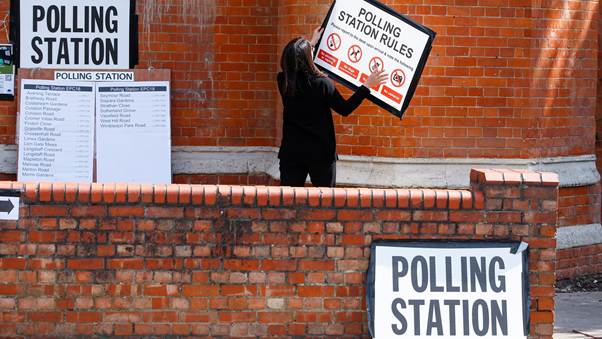
Image source: Polling station rules – don’t get caught out on election day | UK News | Sky News
Application & Exemptions
If you believe your organisation to be among those in the narrow exemptions (official, informational content rather than persuading or campaigning), then you can apply through the Google Help Centre for an exemption.
During the application process, you’ll need to outline clearly why your content qualifies. For example, a government authority running ads to inform citizens of the dates, registration process or modalities for voting. Likewise, Member State bodies or EU institutions can apply to promote neutral election participation content.
As mentioned, you cannot bulk apply. Each individual account must apply for exemption in its own right. This prevents exemptions being misapplied or transferred between advertisers.
Rejected applications can be appealed, but the process takes a while. And in political contexts, delays can be critical.
The underlying principle is simple. Google wants absolute clarity on who is running exempt political content and why. If your case isn’t watertight, approval won’t be likely.
Self-Declaration Requirement
Since mid-August this year, advertisers have been required to self-declare whether they intend to run political ads. This isn’t optional. When you set up or edit campaigns, you’re prompted to answer “Yes” or “No” to the political advertising question.
- Choosing “Yes” will automatically trigger the application of restrictions. Your campaigns will be subject to enforcement processes and you may be required to provide additional verification.
- Choosing “No” while running political ads is considered a false declaration. It’s a violation that could fast-track your account to receive warnings or suspension.
This puts the onus firmly on advertisers. You must understand what counts as political under EU Regulation 2024/900. It’s not safe to assume your content is “issue-based” or “advocacy” rather than political. If the ad is designed to influence legislation, voting behaviour or electoral outcomes, it likely qualifies as political.
From a compliance standpoint, the worst risk is silence. If you failed to declare and your ads are later determined to be political, your account history will show non-compliance. This could mean more scrutiny or longer reputational harm, even if you then correct the issue.
- The safest course of action is to run a campaign audit now. Review creative, landing pages, targeting and budgets to ensure nothing inadvertently crosses into political territory.
Transparency & Verification Changes
Google’s approach to political ads has always centred on being transparent. However, the new rules do change how that transparency looks.
With the new rules, the EU Political Ads Transparency Report was retired. The report had provided aggregated insights into political spending across the bloc. Though this now doesn’t exist, there are still records.
Past EU Election Ads can still be found in the Ads Transparency Center, though the retention period is limited. This means there is a historical record. However, it doesn’t offer the same level of ongoing oversight as it did.
At the same time, advertisers that had undergone EU Election Ads verification were moved automatically into the broader Google Advertiser Verification Program. What this means is that identity checks, documentation and disclosure requirements will now apply consistently across ad categories and not just political.
For advertisers, the key takeaway is this:
- Transparency isn’t optional.
- Your ad activity is still publicly visible. It’s just in a different form.
- Verification requirements are now broader. It’s harder to bypass scrutiny.
It may feel like a reduction in visibility. But in practice, it means Google is simply consolidating oversight into one framework.
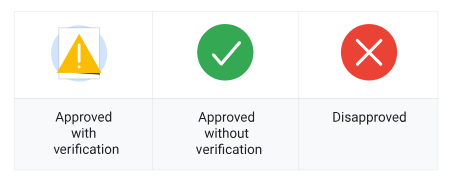
Source: Political content – Advertising Policies Help
Enforcement & Penalties
One of the most significant clarifications from Google was around enforcement. If you violate the political ads policy, your accounts won’t be suspended immediately. Instead, Google will issue at least seven days’ warning before suspension happens.
This means you have time to correct mistakes. You can, for example, pause non-compliant campaigns. Or apply for the appropriate exemptions. However, the grace period doesn’t mean leniency.
The risks are still considerable:
- Campaign pauses. If you discover a key ad stream is blocked during a referendum campaign or major policy debate even seven days’ downtime could cost reach, momentum and credibility.
- Reputational harm. Having ads flagged as non-compliant can damage brand trust. This is particularly true for NGOs, advocacy groups or public bodies.
- Future scrutiny. Accounts that violate the policy may then be subject to stricter checks in the future. This slows campaign approvals and reduces agility.
- Google will issue at least 7 days warning before suspension.
- Risks: campaign pauses, reputational harm, stricter scrutiny for future ads.
If you’re unsure whether your ads are compliant, our PPC search services are designed to help advertisers audit campaigns and avoid costly suspensions.
Risks for Advertisers (Examples)
The biggest challenge? Google’s EU political ads policy has a broad definition of “political.” Many organisations that do not see themselves as political actors may still fall within the definition.
Here are some practical examples:
NGO running a climate law campaign
An environmental NGO runs ads promoting stricter emissions laws. While not party-affiliated, the campaign is designed to influence legislative outcomes. Under the new rules, this counts as political advertising. It is restricted, unless exempt.
Advocacy ground around a referendum
A non-profit launces ads encouraging people to “vote yes” in a sovereignty referendum. This is directly tied to voting behaviour and is therefore prohibited. This is unless the ads are issued by official electoral authorities for neutral participation purposes.
Local political candidate advertising events
A candidate for local council promotes a “meet the candidate” evening via Google Ads. Because the individual is a political actor under Regulation 2024/900, this is explicitly restricted and not permitted.
These examples show how easily well-meaning campaigns can fall foul of the new rules. Even issue-driven content (like climate change or public health advocacy) can cross the line if it’s designed to shape legislation or votes.
Best Practices to Remain Compliant
For advertisers, the safety strategy is to plan campaigns with compliance in mind.
The following best practices can reduce your risk:
- Audit creative and landing pages. Look for explicit or implied references to political actors, policies or legislative outcomes. Even indirect mentions can trigger restrictions.
- Segment EU vs non-EU targeting. Avoid spillover by ensuring political or issue campaigns run outside the EU are not accidentally geo-targeted to EU users.
- Apply early for exemptions. If you believe your campaign qualifies, don’t wait until launch day. Apply weeks in advance so Google and review it. And leave time for appeals.
- Keep records. Keep documentation of ad copy, targeting and budgets. If you’re then questioned, you’ll need to show intent and compliance.
- Separate messaging. Don’t mix commercial and political content within the same campaign structure. This avoids one element of your campaign risking the entire account.
By using these practices, you can continue to run effective campaigns without risking sudden disruption.
Remember, though, that compliance isn’t a one-off task. It’s a continuing process. Even if a campaign launches safely, new creative, policy shifts or audience adjustments can introduce new risks. Regular account reviews will help you catch any potential issues early so you maintain compliance and avoid the stress of any last-minute corrections.
FAQ
What is Google’s EU political ads policy?
Since September 2025, Google has banned political advertising in the EU. There are a few narrowly defined exemptions only. These relate to official, informational content.
Who counts as a “political actor”?
Political parties, alliances, candidates, elected officials, campaign organisations and anyone acting on their behalf are considered political actors under EU Regulation 2024/900. See the definitions in the Regulation policy for more details.
Are any political ads still allowed?
Yes. But only those issued by official EU or Member State sources providing neutral election or referendum information.
What’s the self-declaration requirement?
Since August 2025, advertisers must declare if they plan to run political ads. False declarations can result in enforcement action.
What happened to the Transparency Report?
The EU Political Ads Transparency Report was retired in September 2025. Past ads remain in the Ads Transparency Center. Verification has been folded into the wider Advertiser Verification Program.
What if I violate the policy?
Google will issue a warning at least seven days before suspension. But violations can still lead to paused campaigns and reputational harm.
Conclusion
Google’s EU political ads policy is a fundamental shift for advertisers across Europe. With a clear ban in place, only a handful of official exemptions exist.
Advertisers who fail to act now risk disruption, reputational damage and long-term scrutiny of their accounts. The key to survival under the new rules is proactive preparation. Auditing campaigns, applying for exemptions where necessary and keeping EU and non-EU activity clearly separated is important.
Don’t wait until enforcement catches up with you. Contact us today to review your campaigns and ensure you remain compliant. Taking action now will help prevent suspension but also give you a stronger, safer foundation for future growth.


